
Buying a suit set online becomes easier when you stop trying to judge everything from the first photograph. A beautiful image can tell you whether you like the look. It cannot, by itself, confirm what arrives in the parcel, how the trousers will fit when you sit, whether the kurta needs an inner layer or how much care the embroidery requires.
For a working wardrobe, those practical details matter as much as appearance. The set has to suit your commute, your workplace, the hours you spend wearing it and the way you maintain your clothes. The aim is not to find a theoretically perfect outfit. It is to choose one you understand well enough to wear confidently and often.
This guide walks through ten checks before you buy a ready-to-wear suit set online. Use it with the information on the specific product page and its current size chart. Where a detail is missing, ask for clarification rather than treating a styled photograph or a familiar fabric name as a guarantee.
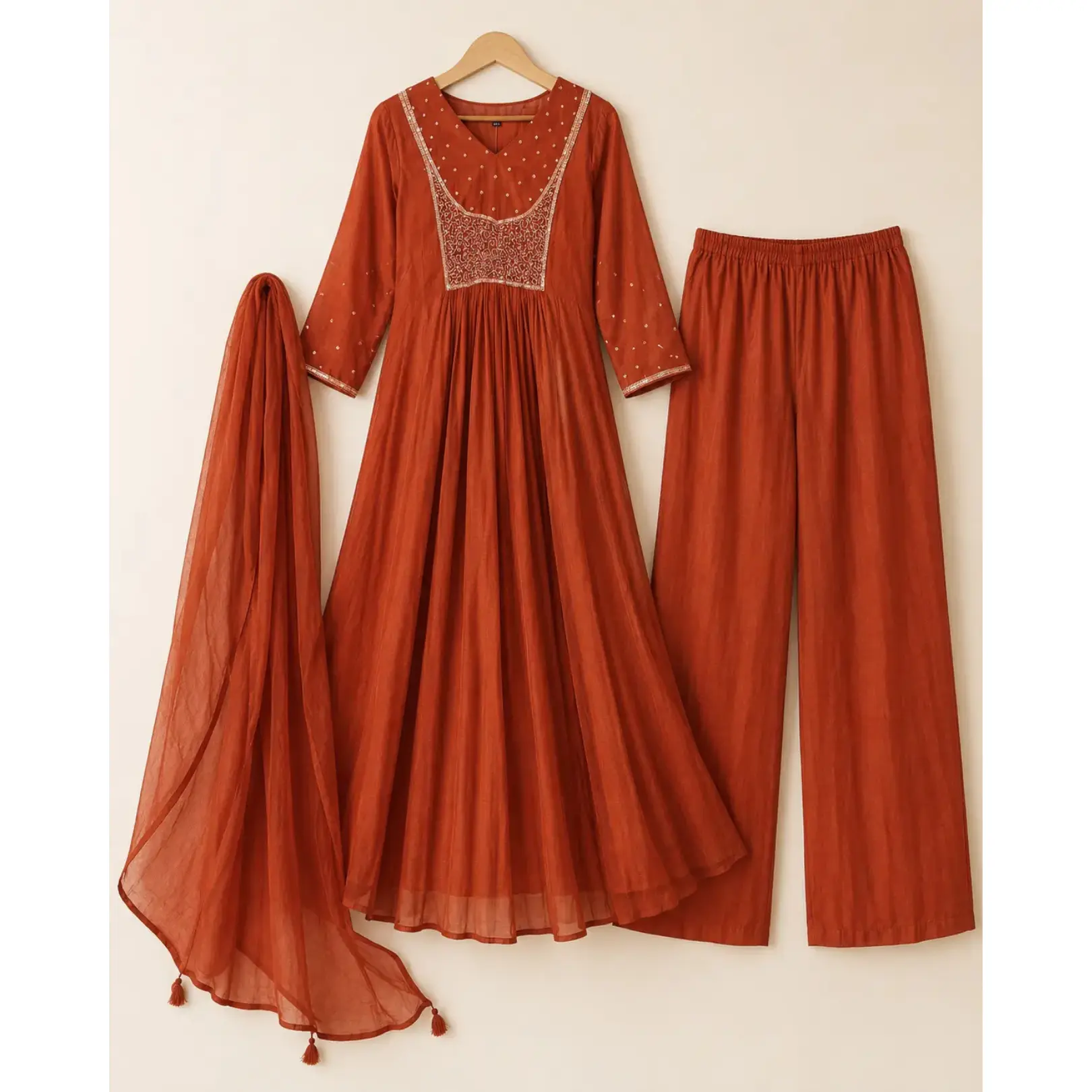
Start with the job you want this outfit to do
Before comparing products, write a one-sentence brief. For example: “I need a coordinated outfit for regular office days, with sleeves that stay out of the way at my desk and trousers comfortable enough for a long commute.” Another brief could be: “I want something for client presentations that I can also wear to dinner with different accessories.” These are different needs, even when the photographs you like look similar.
Choose three essentials and two preferences. Essentials might be a particular coverage level, a practical care routine and a comfortable waistband. Preferences might be a favourite colour or a decorative neckline. This distinction helps when a lovely set meets most, but not all, of your wishes. A preference can sometimes bend; a real comfort or use requirement should not disappear just because a sale is ending.
Our guide to choosing a kurta set for the office can help you define those priorities. Once you know what you need, assess each shortlisted set in the same order instead of restarting your decision from scratch every time you open another photograph.
1. Confirm exactly what the set includes
“Suit set” is not a complete packing list. Depending on the listing, it may describe a kurta and bottoms, a three-piece outfit with a dupatta, or another combination. The photograph may also include shoes, jewellery, a belt, a bag or an inner layer used only for styling. Make the written list of included pieces your starting point.
Read the title, description and any “what is included” section together. If the headline says three pieces but the description names only two, pause and ask. Do not assume that an accessory is included because its colour matches perfectly. Equally, do not assume that a photographed dupatta is optional if it is an important part of the coordinated look you want.
Check whether the photographs show one version
A gallery can contain close-ups, alternative styling and different colour variants. Confirm that the colour and size selected in the buying controls refer to the version you have been examining. A detail visible in one photograph may belong to another option. This is especially important when a listing groups several similar designs together.
For a work wardrobe, think about the pieces individually as well as together. Would you wear the kurta without the dupatta? Do the bottoms work with another top you already own? These questions are about usefulness, not an expectation that every piece must do everything. A coordinated set can still be worthwhile if you love wearing it as a complete outfit.
Finally, distinguish ready-to-wear from unstitched or semi-stitched clothing. Check that the description actually matches the kind of purchase you intend. If any tailoring, finishing or separate lining is required, include that effort in your decision before placing the order.
2. Read the fabric information for every piece
The kurta, bottoms, dupatta and lining may use different materials. A single fabric word in a title does not necessarily describe the whole set. Look for a separate fabric description for each component, including the lining when one is present. If the composition is important to you, ask for the stated fibre content rather than relying only on a trade or marketing name.
Fibre, weave, thickness, finish and construction all affect how a garment behaves. Two fabrics with similar names can feel and drape differently. A soft-looking photograph does not establish softness against your skin, and a fluid-looking pose does not tell you how the outfit feels after several hours at a desk.
Connect the fabric to your actual day
Consider where you will wear the set. Someone moving between a warm commute and a cool office may need a different layering plan from someone mostly working indoors. A lighter-looking kurta may still need an inner layer; a substantial-looking fabric may be cut loosely. Evaluate the complete garment rather than using the fabric label as a shortcut for comfort.
Look for useful evidence in the images: how the fabric falls from the shoulder, whether the hem has structure, how the dupatta drapes and whether the bottoms hold a sharp line or a softer shape. Video, when available, can add context about movement. None of these replaces the written composition or care instructions.
If you have strong preferences about stretch, texture or transparency, ask specific questions. “Does the trouser fabric stretch, and is the waistband adjustable?” is easier to answer than “Is it comfortable?” Avoid assuming that a fabric is wrinkle-free, non-shrinking, colourfast or suitable for machine washing unless the product information supports that claim.
3. Understand what the size-chart numbers mean
Start with the chart attached to the particular product, not the size you usually buy elsewhere. Letter sizes are labels, not universal measurements. Even within a brand, different cuts can feel different. A fitted upper body and a relaxed straight shape may need different considerations although both carry the same size label.
Check whether the chart gives body measurements or finished garment measurements. Body measurements describe the wearer the size is intended for; garment measurements describe the clothing itself. Confusing the two can lead to a set that is unexpectedly tight or much looser than you wanted.
Take useful measurements, not hopeful ones
Use a flexible tape, stand naturally and avoid pulling it tight. Measure over the kind of undergarments you expect to wear with the outfit. Record the units as well as the numbers. If someone can help check that the tape stays level around the bust and hips, that can make the process easier.
For finished garment measurements, compare with a similar garment that already fits you well. Lay it flat without stretching and follow the same measurement method where it is explained. A flat width and a full circumference are not interchangeable, so confirm which the seller provides before comparing them.
Review more than the bust measurement. Shoulders, upper arms, hips, waist, garment length and trouser measurements may all affect comfort. The most relevant points depend on the cut. If your measurements fall across different sizes, do not automatically size down or up based on a single number. Ask about the specific areas that would be tight, and whether the design allows straightforward alteration.
For a more detailed process, read how to find the right fit in a ready-to-wear suit set. The goal is to understand the likely fit before ordering, not to promise that a chart can replace every aspect of a physical trial.
4. Check kurta length, shape and side openings
A kurta can look knee-length on one person and longer on another. The model’s height, footwear and pose all affect that impression. Look for the actual garment length and compare it with a kurta you own. Decide where you want the hem to sit on your body rather than assuming it will fall exactly where it does in the image.
Notice the silhouette from more than one angle. A straight kurta, an A-line shape and a flared design distribute fabric differently. Front photographs can hide fullness at the sides or back. If the gallery provides a side view, use it to understand the outline rather than looking only at the embroidery.
Think about movement as well as appearance
Side slits and the width around the hips can affect walking and sitting. A long, narrow garment may behave differently from a shorter or more flared one. The purpose of checking these details is not to reject a style, but to understand whether it fits your routine. Consider stairs, public transport, your office chair and any periods of standing.
Ask yourself whether you are comfortable with the coverage created by the slits and the accompanying bottoms. If you intend to wear the kurta separately, reassess that combination too. The original set may be styled to work as a whole, and changing the bottoms can alter both the appearance and the coverage.
Do not make the purchase depend on an unconfirmed alteration. Shortening a plain hem may be simpler than changing a hem with a border or embroidery, but feasibility depends on the garment. If the desired length is essential, get clear measurements before buying rather than planning to solve a major proportion issue afterwards.
5. Examine the trousers as carefully as the kurta
The kurta often receives most of the attention, while the trousers determine much of the day’s comfort. Look for the bottom style, length, waist construction, rise and fit through the hips and thighs. A narrow trouser, a wider leg and a gathered bottom create different looks and can feel different when sitting or walking.
Confirm whether the waist is fully elasticated, partly elasticated, fixed, drawstring-adjusted or fastened with a zip and button. A waistband described as elasticated does not tell you its comfortable range by itself. If the chart provides relaxed and stretched measurements, make sure you understand how to use both.
Look beyond the waist number
A waistband may fit while the hips or thighs do not. Consider your seated comfort, not only whether the trousers would close while standing. If the set is sold in one combined size, ask how the top and bottom measurements correspond when you normally need different sizes for each.
Check pockets if you rely on them, but do not infer their presence from the model placing a hand near a side seam. Where pockets are included, consider whether carrying a phone or keys may change the line of the garment. A bag may still be the more practical option for a polished outfit.
Compare trouser length with the shoes you plan to wear. A hem that works with one heel height may sit differently with flats. If you commute in one pair and change shoes at work, consider both. Wide hems should not depend on constant lifting or dragging, and a cropped style should be a deliberate preference rather than a surprise caused by missing measurements.
6. Inspect the neckline, sleeves and closures
These details affect how often you adjust an outfit during the day. Look at neckline shape and depth, sleeve length and width, cuffs, buttons, hooks and any opening used to put the garment on. Styling can make a neckline appear higher or more closed than it is, particularly when a dupatta covers part of the upper body.
Choose coverage according to your comfort and workplace requirements, not a universal rule about what working women should wear. Think about leaning forward, reaching across a table and sitting on a video call. If the neckline is a deciding factor, ask for its measurement or a clearer view rather than guessing.
Make sleeves work for your routine
Long or wide sleeves can look beautiful, but consider whether they suit typing, eating, handling papers or carrying items. A detailed cuff might be a favourite feature for meetings and less convenient for hands-on work. Three-quarter or shorter sleeves may be practical for some routines, but the best choice is the one that fits yours.
Look at upper-arm room as well as sleeve length. A sleeve can appear generous at the wrist and still be restrictive higher up. If you frequently find sleeves tight, ask for the relevant measurement instead of choosing the entire outfit solely by bust size.
Check whether visible buttons are functional or decorative if that matters to how you dress. Similarly, do not assume that a front opening, nursing access or adjustable closure is present unless it is stated. Small construction details are worth clarifying before purchase because they may not be easy to change without affecting the design.
7. Clarify lining, transparency and inner-layer needs
A light colour is not automatically transparent, and a darker colour is not automatically opaque. The fabric, weave, thickness, lining and lighting all matter. Studio photographs can make it difficult to assess coverage, particularly when the background and underlayers are carefully selected.
Look for a clear statement about lining in both the kurta and the bottoms. “Lined” may refer to only one piece or one part of the garment. If coverage is important to your decision, ask whether the lining extends through the full garment or only selected areas, and what the lining material is.
Consider the complete layering arrangement
If you intend to add an inner layer, allow for it when considering fit and comfort. An extra layer may change how the garment feels, how warm it is and how freely it moves. Make sure its neckline and hem are compatible with the kurta rather than treating it as an invisible solution to every coverage concern.
Do not assume a dupatta provides the coverage you need in all positions. You may remove it at your desk, shift it during travel or style it differently for dinner. If the outfit only feels comfortable when the dupatta is held in one precise position, decide whether that arrangement is realistic for your day.
When an outfit arrives, assess it under the ordinary indoor and daylight conditions in which you will wear it, while respecting the seller’s trial and return conditions. This is a practical check, not permission to wear, wash or alter an item before deciding whether to keep it.
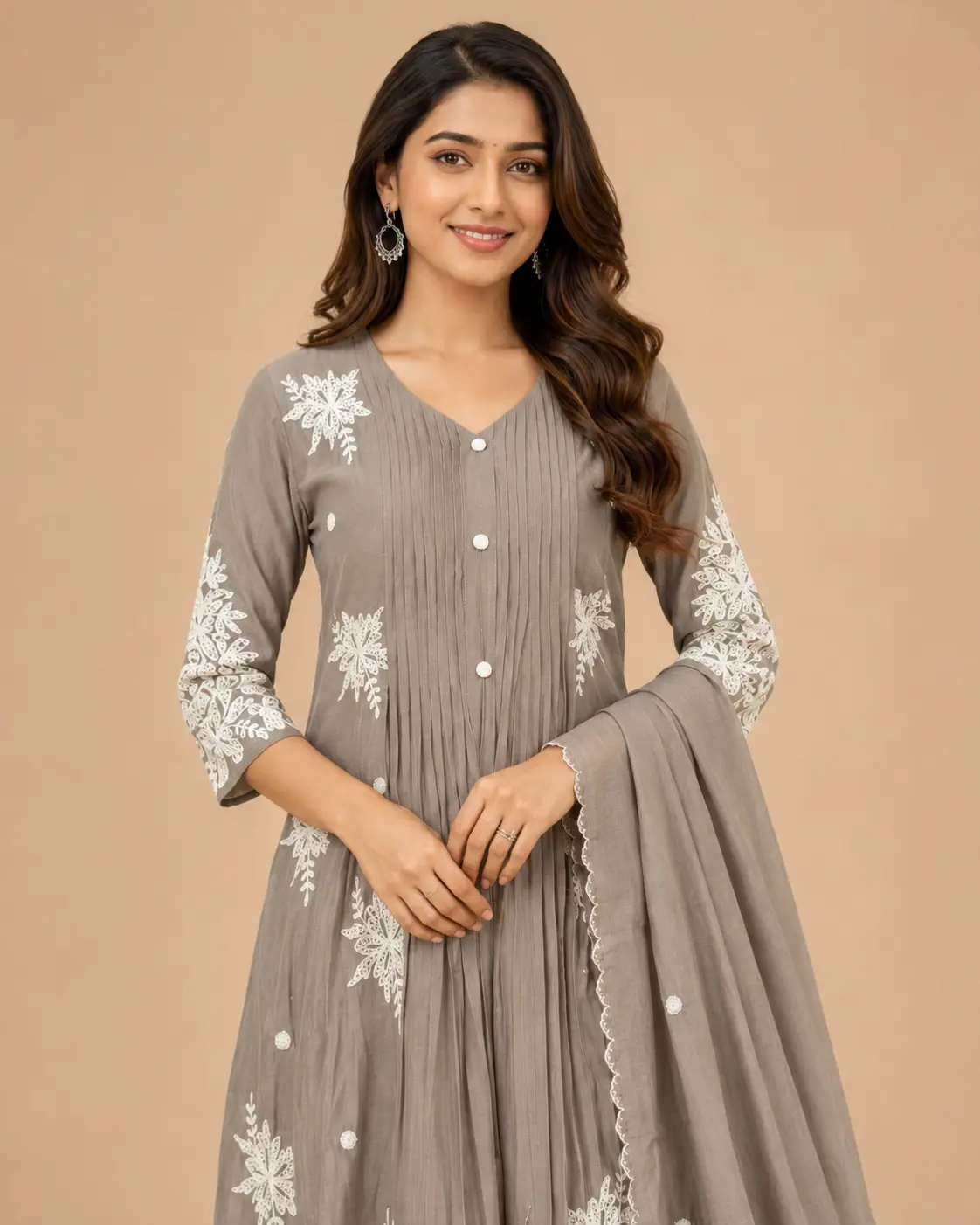
8. Separate colour, embroidery and finishing evidence
A complete outfit photograph helps you judge overall balance. Close-ups answer different questions: where embroidery sits, how much contrast it creates and whether the detail is concentrated at the neckline, sleeves or hem. Use both views rather than deciding from a highly cropped decorative image alone.
Terms such as embroidered, embellished, printed and woven are not interchangeable. If the technique matters to you, read the description carefully. Do not infer handwork from an intricate appearance or assume that every decorative effect is stitched. The method should be confirmed in the product information when it is part of your buying decision.
Judge detail in the context of your workplace
Think about what will be visible when you sit behind a desk or join a video meeting. A detailed neckline may become the strongest feature in that view. A border at the hem might be more noticeable when standing. Neither is inherently better; the question is whether the placement supports the look you want.
For colour, compare the written shade description with the full set and close-up images. Screen settings and lighting can affect what you see. If an exact match with an existing garment or event colour is essential, explain that requirement to the seller and ask what evidence they can provide. A photograph cannot guarantee an exact screen-to-fabric match.
Use our guide to a polished workwear colour palette to think about combinations rather than rigid colour rules. You may find that a set works well with your wardrobe even if it is not an exact match to everything you own.
Finally, examine visible seams, edges and closures where the photographs allow. Images can help you identify questions, but they do not prove long-term durability. Avoid equating a high price, a familiar label or elaborate embroidery with guaranteed construction quality.
9. Check care requirements and repeat-wear potential
The practical cost of an outfit includes looking after it. Read the care instructions before buying, particularly when the set combines different materials or decorative elements. If professional cleaning is required, consider whether that fits your budget and routine for the frequency you expect to wear the outfit.
Do not substitute general advice about a fibre for the specific garment’s care instructions. Embroidery, lining, dyes, trims and construction can affect suitable cleaning methods. If the listing does not provide clear guidance, ask before assuming you can machine wash or iron it in the same way as a simpler garment.
Picture three real occasions
Name three occasions already present in your life when you would wear the set. They might be regular office days, client meetings and family lunches, rather than three hypothetical special events. This exercise helps separate a useful addition from an outfit you admire but are unlikely to reach for.
Then test it against your existing accessories. Can you wear it with shoes and a bag you already own? Does it need a special inner layer? Would a different dupatta or jewellery choice make it suitable for an evening plan? These questions can reveal hidden expenses without suggesting that every purchase must be completely neutral or interchangeable.
Be realistic about storage, pressing and time. If your mornings are rushed, a garment that needs delicate preparation before every wear may be better saved for occasional use. That does not make it a poor purchase; it means it belongs in a different part of your wardrobe.
Repeat wear also depends on fit and personal preference. A carefully coordinated set that feels like you may be worn more often than a theoretically versatile outfit you never enjoy. Use practicality to support your taste, not to erase it.
10. Read the purchase details before the final click
Once the garment itself makes sense, check the transaction. Confirm the selected size and colour, the included pieces, the final amount shown at checkout and the delivery address. Review any shipping charges or other additions before payment rather than relying only on the price displayed earlier in the journey.
Read the seller’s current delivery information and any estimate shown for your destination. Dispatch and delivery are different stages. If you need an outfit for a fixed date, leave room for uncertainty and for checking the fit when it arrives. Do not treat an approximate delivery window as a guaranteed event-ready deadline.
Understand what happens if it does not work
Check the current return and exchange terms for that specific item. Look for eligibility, the time window, how to initiate a request, any costs, the condition required and how refunds or credits are handled. Sale items, altered pieces or other categories may have different conditions; do not assume a general banner answers every case.
If two pages appear to conflict, ask for clarification before ordering. Keep the relevant order confirmation and the seller’s answer so you can refer to the same information later. This guide does not state Inara’s current policy terms: use the policy and product information displayed at the time of your purchase.
For unresolved product questions, use the contact page and describe the exact garment, size and issue. A precise question is more useful than asking whether an outfit is “good quality” or “perfect for office.” Once the essential details are clear, you can browse the shop with a more focused shortlist.
A simple comparison sheet for your final shortlist
When two or three sets seem equally appealing, compare the same facts rather than reopening every image and relying on memory. Make a short note for each: included pieces, fabric details, size confidence, preferred length, trouser construction, coverage, care, total cost and delivery suitability. Write “not confirmed” wherever information is missing. An unanswered point is not automatically a fault, but it should remain visible in your decision.
Do not give every factor equal weight. If you need the outfit for a long seated day, trouser comfort and upper-body movement may matter more than a decorative border. If it is mainly for occasional presentations, the neckline, silhouette and overall effect may take priority. Your shortlist should reflect your use case rather than a generic idea of the best suit set.
A useful decision rule is to separate “ready to choose,” “needs one answer” and “not right for this purpose.” The middle group is often where a brief conversation with the seller saves time. The last group does not mean the outfit is unattractive or badly made; it simply does not solve your current wardrobe need.
Questions you can ask before buying
Here is a concise message you can adapt: “I am considering this suit set in size __. Could you confirm whether the chart gives body or garment measurements, the kurta and trouser lengths, and whether both pieces are lined? I also want to check the included pieces and the care instructions.” Add the exact product name or reference when contacting the seller, so there is no confusion between similar designs.
If your concern is more specific, ask only what you need. For example: “The bust measurement looks suitable, but I need more room at the upper arm. Could you provide the sleeve measurement and explain how it is taken?” Another useful question is: “Does this waistband have a fixed front with elastic at the back, or is it elasticated all around?” These questions invite factual answers that help you decide.
Avoid asking the seller to promise how an outfit will feel on your body or whether everyone at your office will consider it appropriate. Share your requirements, request the missing facts and make the final style judgement using your own comfort and setting.
When the parcel arrives: check before committing to wear
Open the package carefully and compare the contents with your order. Check the colour selection, size label and number of pieces, then look over seams, closures and decorative areas. Keep packaging and tags intact until you understand the applicable conditions and have decided whether to keep the set.
Try the outfit in a clean setting with the underlayers and footwear you intend to use, following the seller’s trial conditions. Stand, sit, take a few normal steps and gently reach forward. Notice where you feel restriction, whether you keep adjusting the neckline and how the trousers sit when seated. A fit that only works in a still mirror pose may not serve a full workday.
If something seems wrong, document the issue clearly and contact the seller through the stated process promptly. Do not wash, alter or wear the garment out while expecting it to remain eligible for return. The appropriate next step depends on the actual policy and the nature of the problem, not on a general assumption about online shopping.
Frequently asked questions
Should I always choose a larger size for comfort?
No. A larger size may add room where you need it, but it can also change shoulder placement, neckline fit and overall proportions. Use the product chart, identify the area that concerns you and ask about garment measurements. Comfortable fit is about the right distribution of room, not simply choosing the largest available option.
Can I judge fabric quality from a close-up photograph?
A close-up can show texture, embroidery placement and some finishing details. It cannot fully establish feel, strength, opacity or how the fabric behaves after cleaning. Combine photographs with composition, construction and care information. Where a property is essential to your purchase, ask directly rather than assuming the image proves it.
Is a three-piece set always better value than a two-piece set?
Not necessarily. Value depends on the pieces you will actually use, their suitability and the total cost of wearing and maintaining them. A dupatta can complete a look and offer styling options, but a two-piece outfit may suit your everyday routine better. Compare the contents and your likely use rather than only the piece count.
What if I love the kurta but the bottoms are not right for me?
Check whether the seller offers separate sizing or another arrangement, without assuming that it does. If the set is sold together, assess whether the complete purchase still makes sense. Buying with the intention of replacing the bottoms can add cost and may defeat the simplicity you wanted from a coordinated outfit.
Should a workwear purchase be neutral to be useful?
No. Colour can work well in a professional wardrobe when you enjoy wearing it and can combine it easily with your accessories. A familiar accent colour may be more useful than a neutral you dislike. Focus on the complete outfit, the level of detail and your workplace context instead of treating one palette as universally correct.
Buy with a clear picture of the whole outfit
A considered online purchase brings appearance and practical information together. Confirm the pieces, understand the fabric and measurements, inspect the construction, plan the care and read the purchase terms. Then choose the set that fits your real routine and personal style. The best outcome is not an outfit that looks impressive only in its listing, but one you are pleased to reach for when an ordinary working morning begins.
