
A good office kurta set does not need to announce itself before you enter the room. It needs to suit your working day: the journey there, the chair you sit in, the people you meet and the plans you may have afterwards. The most useful choice is usually the one that combines a comfortable fit, a clear silhouette and details you enjoy wearing, rather than the outfit with the most embroidery.
If you are choosing online, begin with five questions. What is the dress code? What will you actually do in the outfit? Which parts of the set are included? Are the garment measurements suitable for you? And can you care for it realistically? Those questions will tell you more than a label such as “premium” or “office perfect” on its own.
This guide walks through the decision in a practical order. You do not have to buy a completely different wardrobe to look polished. You need to recognise which features support your routine, which details deserve a closer look and which uncertainties should be cleared up before you order.
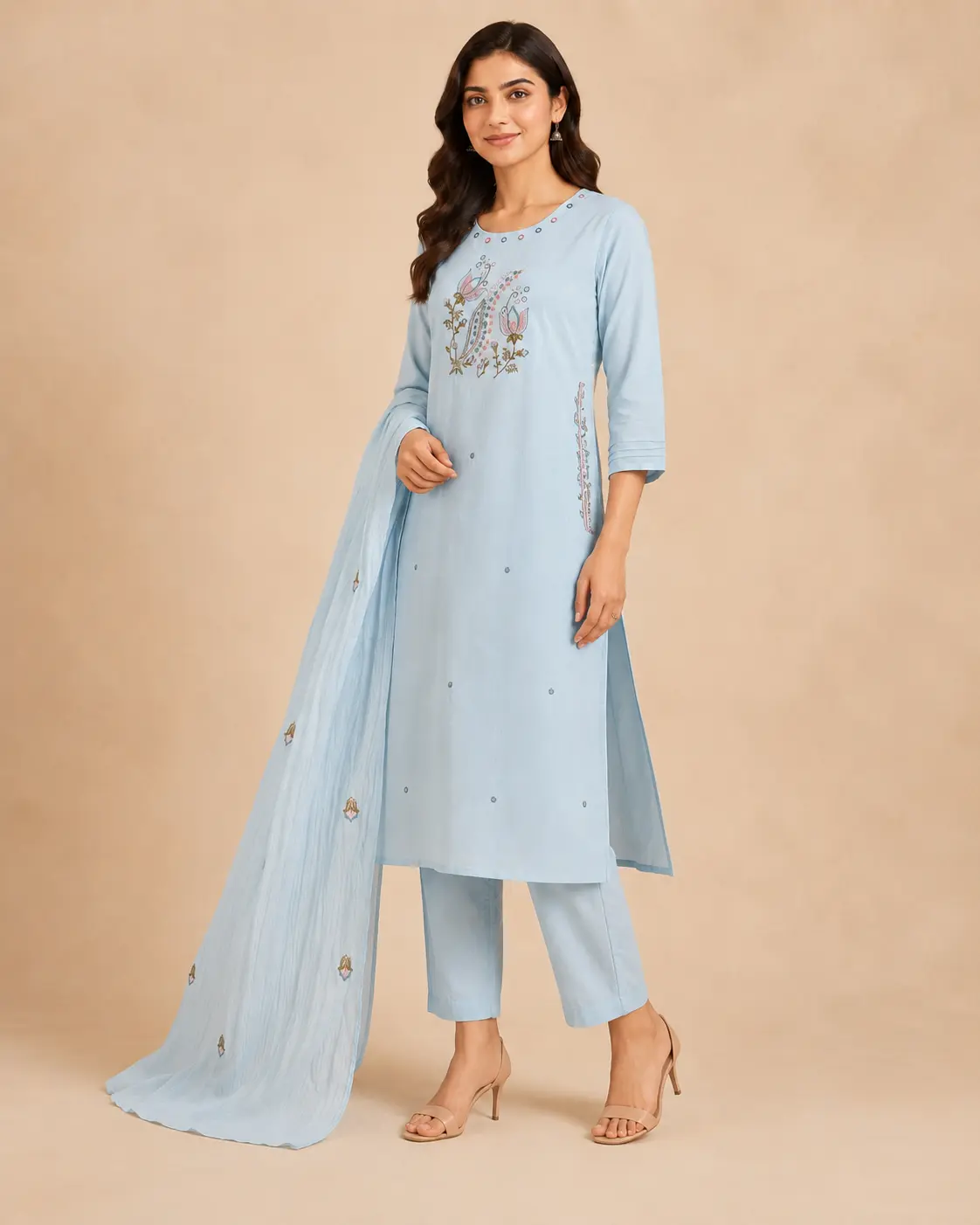
1. Start with your real working day, not an ideal photograph
Picture an ordinary day from leaving home to returning. Perhaps you spend an hour commuting, move between desks and meeting rooms, and stop for groceries afterwards. Perhaps you work from home but appear on video calls. Perhaps your day includes teaching, client visits or standing for long periods. Each situation asks something different of your clothes.
For a desk-heavy day, check how the waist, hips, sleeves and neckline feel when seated. For a mobile role, think about stride, the length of the hem and whether you can carry a bag without displacing the dupatta. For video calls, the neckline, shoulder fit and upper-body detailing may matter more than an elaborate border that never appears on screen.
Write a simple three-line brief before browsing: “I need this for regular office days. I travel by car and walk between buildings. I want to wear it with flat shoes.” That brief makes a useful filter. It prevents a beautifully styled occasion outfit from becoming a purchase that stays in its cover because it does not fit your routine.
Also consider how often you expect to wear the set. A frequently worn outfit needs a care routine you can sustain, not merely a first-day look you admire. Something that requires specialist cleaning may still be worthwhile, but it belongs in a different part of your wardrobe from the set you reach for every Monday.
2. Interpret “professional” within your workplace
There is no single Indian office uniform. A creative studio, school, bank, family business and corporate head office may have very different expectations. Even within one organisation, a normal working day can feel different from a presentation to senior leadership. Start with the written dress policy where one exists, then consider the setting and your role.
A polished outfit generally feels intentional: the pieces work together, the fit allows normal movement and the finishing is cared for. That does not mean colour, embroidery or Indian silhouettes are unprofessional. It means selecting their scale and combination thoughtfully. A richly coloured kurta with restrained accessories can look quieter than a pale outfit with several competing embellishments.
When you are unsure, use an outfit you already feel comfortable wearing to work as a reference. What makes it dependable? Is it the neckline, the sleeve coverage, the simplicity of the bottoms or the way the fabric falls? You can look for those qualities in a new set without buying an exact copy.
For a particularly formal appointment, ask about the setting rather than guessing from a job title. A client meeting in a relaxed studio may call for a different balance from a formal boardroom presentation. The aim is to feel appropriately dressed and able to focus, not to make a universal rule about what women should wear.
3. Choose the shape before choosing the decoration
The silhouette determines how an outfit occupies space and moves with you. A straight kurta generally has a more direct line through the body. An A-line shape widens gradually towards the hem. An Anarkali usually has a more pronounced flare, although the construction and volume vary between garments. Product names are helpful starting points, but photographs and measurements should confirm the actual cut.
For regular desk work, think about how much fabric you prefer around your chair and legs. Some people enjoy a gentle A-line shape because it feels easy when sitting. Others prefer a straight silhouette for its compact outline. A softly flared garment can work well too, provided the length and volume suit your day. None of these choices is automatically better for a particular body.
Look at a front view, a side view and, where available, a walking view. The front photograph shows proportion, while the side helps you judge volume that may be less obvious head-on. Do not infer exact garment width from a pose. A hand pulling the fabric outward can exaggerate flare, and a turned body can make a relaxed garment appear narrower.
If the terms are confusing, our guide to straight, A-line and Anarkali silhouettes explains how to compare them through practical workday needs rather than rigid styling rules.
4. Treat fit as a set of measurements, not a letter
The size you usually buy is a useful clue, not a guarantee. A label such as L, XL or 2XL can represent different measurements across brands, cuts and individual products. Read the chart for the exact garment or set you are considering. Establish whether the numbers describe body measurements or finished garment measurements before comparing them with your own.
For a kurta, important areas include the bust, shoulder, upper arm, waist or midsection, hips and overall length. A straight garment may need particular attention through the hips. For bottoms, check waist, hip, rise and length wherever those details are available. A comfortable kurta does not compensate for bottoms that feel restrictive when seated.
Compare the information with a similar garment you already like. Lay that garment flat and measure it consistently with the seller’s instructions. Do not compare a flat half-width directly with a full circumference. If the chart is unclear, asking for clarification is more reliable than assuming a conversion.
The useful question is not “Can I get into it?” but “Can I wear it through the activities I need to do?” Look for comfortable movement without obvious pulling or unnecessary excess. For a more detailed method, use our ready-to-wear suit-set fit guide before selecting a size.
5. Check length in relation to yourself and your shoes
A kurta can look different on two people even when they wear the same labelled size. Height, torso length, shoulder position and footwear all influence where the hem appears to finish. A model photograph is a styling reference, not a measurement chart. If the model’s height or garment size is not provided, do not fill in the missing information from appearance.
Use the stated garment length and compare it with something you own. If you like a kurta that finishes below your knee, measure that garment rather than searching for an arbitrary “ideal” length. Then consider where the side openings finish and whether the bottoms remain visible in a way you enjoy.
Footwear changes the practical picture. An outfit that clears the floor in heels may brush the ground in flats. A wide lower garment can also behave differently on steps or during a commute. You do not need to style every outfit with high heels to make it work; choose a length that supports the shoes you genuinely wear.
If alteration seems necessary, understand what it might affect. Shortening an embroidered hem can change the border placement or proportion. Do not assume every garment can be altered simply. Ask about construction first, especially when the design depends on a detailed edge, panel arrangement or coordinated bottom.
6. Read the fabric details for every component
A three-piece set may use different fabrics for the kurta, bottoms and dupatta. The headline name does not always describe all three. Read the component details individually. If the kurta is listed as cotton, for example, that alone does not establish the composition of the lining or dupatta.
Fabric names also do not answer every comfort question. Thickness, weave, lining, finishing and construction affect how a garment feels. A lightweight-looking image cannot prove breathability, opacity or softness. Where a particular property matters to you, look for a clear description, a close-up or direct clarification rather than relying on adjectives.
Think about your environment. An outdoor commute and an air-conditioned office can create different needs in the same day. A layering piece you already own may be useful, but check how it sits over embroidery and sleeves. A set that looks lovely beneath a jacket may become awkward if decorative cuffs bunch inside the jacket sleeves.
Care is part of fabric choice. Read the instructions before buying, not after the first wear. If your routine only accommodates easy home care, be realistic about a garment that requires a different process. If you are happy to arrange specialist cleaning, that opens other possibilities. The right choice is the one whose appearance and maintenance both fit your life.
7. Understand lining and opacity without guessing
Light colours can look beautiful at work, but colour alone does not tell you how much a fabric reveals. Dark fabric is not automatically opaque either. Lighting, weave, thickness and layers all matter. Ask whether the garment is lined and, if it is, which areas are lined. A lined body with unlined sleeves is different from a fully lined kurta.
Look for photographs that show the garment under normal lighting, not only dramatic backlighting or heavily edited studio conditions. Even good images have limits. If opacity is important to your comfort, a specific answer from the seller is more useful than a reassuring assumption based on one photograph.
Consider what you intend to wear underneath and whether the neckline and armholes work with it. If you prefer an additional layer, check that the garment has enough room for it without pulling. Extra layers can also change how warm the outfit feels, so include that in your decision.
When the outfit arrives, inspect it in the conditions in which you will wear it while following the seller’s trial and return instructions. Stand, sit and view it in daylight and indoor light. This is a personal suitability check, not a reason to expect every fabric to behave identically in every setting.
8. Let embroidery have a clear role
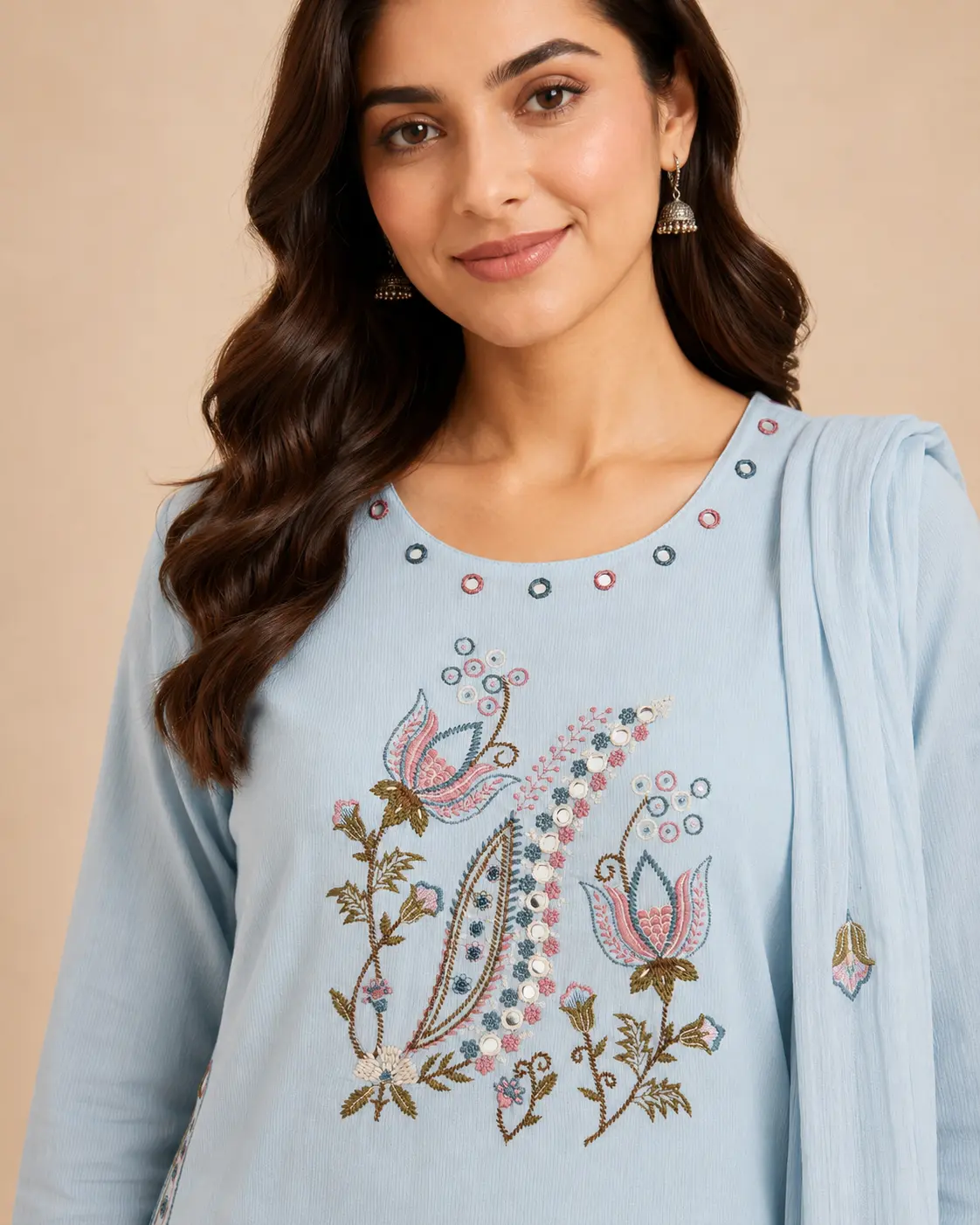
Embroidery can make a workwear outfit feel distinctive without making it ceremonial. Placement often matters as much as quantity. A detailed neckline creates a different impression from a broad hem border or an all-over pattern. Start by deciding where you want the visual focus, then give that detail enough space.
If the neckline is richly worked, you may prefer to skip a necklace. If the sleeves carry the main detail, a simple bag and restrained bracelet can prevent the area from feeling crowded. These are options, not rules. The point is to make deliberate choices instead of adding accessories because an outfit seems incomplete without them.
Inspect close-ups for the actual type of work described. Thread work, metallic-looking detailing and printed effects are not interchangeable. A photograph should not be used to declare that something is handmade or that a particular fibre or metal has been used. Those claims require reliable product information.
For daily wear, also think about contact points. Decorative elements may meet the edge of a desk, a handbag strap or a jacket. Consider how you move and what you carry. Our guide to choosing embroidery for office wear explores how to balance visual interest with the practical details of a working day.
9. Choose colour for your wardrobe, not for a fixed rulebook
Colour is most useful when it works with the items you already reach for. Before choosing a new set, look at your shoes, bags and light layers. A colour you love becomes easier to wear when it has at least one familiar partner. You do not need every accessory to match precisely; a coherent palette can include contrast.
Neutrals may simplify pairing, while deeper shades, muted colours or bright accents can bring individuality to office dressing. There is no need to assign colours to age groups or tell people that one skin tone should avoid a shade. Personal preference, workplace context and the balance of the complete outfit are more useful considerations.
Pay attention to the accent colour as well as the base. A soft kurta with a contrasting embroidered neckline may pair differently from a plain garment in the same base shade. If a set comes in several colourways, check the selected variation’s photographs and details rather than assuming only the background colour changes.
Screens and lighting can affect appearance. A descriptive colour name is helpful, but it is not a calibrated colour standard. If you need a very specific match for an event, ask for clarification before ordering. Avoid making the purchase depend on an exact screen-to-fabric match that an online image cannot reliably promise.
10. Give the bottoms equal attention
It is easy to focus on the kurta and treat the bottoms as a supporting detail. In daily use, they have a major effect on comfort and the overall line of the outfit. Check whether the set includes straight pants, a relaxed trouser, salwar, churidar or another cut. These are different constructions, not simply different names for the same thing.
Look at the waist treatment, available measurements and the way the lower garment falls in the photographs. An elasticated waistband does not automatically mean every size will feel comfortable. Nor does a loose-looking leg establish how much room there is at the hip or rise. Measurements remain important.
If the image shows gathered fabric around the ankle but the description says straight pants, resolve the discrepancy before buying. Similarly, do not assume pockets, lining, a drawstring or a particular closure unless the details confirm them. Small features can become daily frustrations when they matter to you and are missing.
Try to imagine the bottoms with your usual shoes and with the kurta at its real length. The visible section of the lower garment contributes to proportion. A coordinated set should feel useful as a whole, even if you later enjoy wearing its pieces separately with other items you own.
11. Make the dupatta manageable, not mandatory decoration
A dupatta can frame the outfit, add colour and provide a useful layer. It can also require more attention than you want during a busy day. First confirm whether it is included. Then check its fabric, length and detailing where provided. A heavily embellished edge behaves differently from a simple lightweight finish.
Choose a drape that matches your activities. For desk work, you may want the fabric arranged so it does not keep falling across your hands. For a presentation, you may prefer a secure, uncomplicated placement. If you use a pin, be mindful of the fabric and test it carefully; not every delicate weave tolerates the same treatment.
You can also decide whether the kurta and bottoms work well without the dupatta for parts of the day. That is a styling preference, not a promise that every set is designed for every combination. Consider neckline coverage, pattern balance and your workplace’s expectations.
Before buying, avoid judging the entire outfit only through an elaborate editorial drape. Look for a view that makes the kurta visible. If the dupatta hides much of the garment in every photograph, ask for a clearer view. The decorative layer should not make essential product details impossible to evaluate.
12. Use accessories to support the outfit
A complete workwear look does not require a long accessories list. Begin with the items you need: comfortable footwear, a practical bag and any everyday jewellery you already enjoy. Then decide whether the outfit benefits from anything else. Often the answer is less than the styled photograph suggests.
For a detailed neckline, small earrings may be enough. For a simple kurta, a slightly more noticeable pair can add interest. Consider weight and movement according to your own comfort rather than assuming an accessory is wearable for an entire day. What suits one person may not suit another.
Choose footwear according to your actual movement. Flats, low heels or other workplace-appropriate shoes can all work, depending on the outfit and setting. Check that the trouser or kurta hem does not catch. A shoe that looks elegant in a photograph but makes your commute difficult is not solving the right problem.
A structured bag can sharpen a relaxed silhouette, while a simpler bag can quiet a more detailed outfit. Check the strap against embroidery or delicate fabric. There is no need to replace all your accessories to make a new set feel polished. A thoughtful combination of familiar pieces is often more convincing than a completely unfamiliar look.
13. Compare two shortlisted sets fairly
Once you have narrowed the options, stop comparing only the hero photographs. Put the practical details side by side. Which set has the measurements you need? Which has clearer component information? Which can you wear with your existing shoes? Which care routine is realistic? These questions often reveal a better choice than a quick visual preference.
Make a small note for each option with four headings: purpose, fit, care and uncertainty. Under purpose, record the situations you expect to wear it in. Under fit, note the measurements you have checked. Under care, record the actual instructions. Under uncertainty, list anything that needs an answer before ordering.
Price belongs in this comparison, but it should not be the only column. A less expensive set is not automatically better value if it does not fit your needs. A higher price is not proof of superior construction either. Look for visible and documented reasons for your preference, rather than letting a discount label make the decision for you.
If you remain undecided, choose the set that solves the more frequent problem in your wardrobe. A dependable weekday outfit may be more useful than another special piece when your real difficulty is getting dressed for routine office days. Conversely, if your daily wardrobe is already strong, a meeting-ready addition may fill the gap.
14. Three workday examples to make the choices concrete
A regular office day with a long commute
Prioritise a fit that lets you sit and walk comfortably, a length that works with your usual shoes and details that do not need frequent adjustment. A relatively simple silhouette with a manageable dupatta may suit this brief. Check the care instructions and actual component fabrics before calling the set an easy everyday option.
A presentation followed by a work lunch
Think about the visible upper half on screen or across a table, then make sure the whole outfit works when you stand. A clear neckline, comfortable sleeves and one intentional decorative focus can help the look feel organised. Choose accessories you are used to wearing so they do not become a distraction during the presentation.
A normal day followed by dinner
Choose the base outfit for the longer part of your day, not just the evening photograph. You might change earrings, shoes or the dupatta arrangement afterwards. That keeps the transition manageable. Our office-to-dinner styling guide develops this approach without turning it into a list of additional purchases.
These examples are decision frameworks, not fixed outfit prescriptions. Your workplace, comfort preferences and existing wardrobe should determine the final choice. The same set may serve more than one situation, but it does not need to serve every situation to be worth owning.
15. A final checklist before placing the order
- Purpose: I can name the working days or occasions this set will serve.
- Contents: I know which garments are included and which photographed accessories are not.
- Fit: I have checked the relevant size chart and understand what its measurements describe.
- Length: I have compared the kurta and bottom lengths with garments or shoes I use.
- Fabric: I have read the details for the kurta, bottoms, dupatta and lining separately where available.
- Design: I have inspected the selected colourway and close-ups, not only the first photograph.
- Care: The stated care process fits my routine.
- Policies: I have read the current delivery and return information rather than assuming a standard policy.
- Uncertainty: I have asked about any missing detail that would change my decision.
When something important is unclear, use Inara Ethnic’s contact page to ask a specific question. “Is the kurta lined, and what fabric is the lining?” is easier to answer accurately than “Is it good quality?” Specific questions help you choose with confidence without relying on broad assurances.
16. Check the outfit thoughtfully when it arrives
Read the seller’s trial and return conditions before removing tags, washing or altering anything. Inspect the pieces supplied, the colourway, visible seams, closures and embroidery. Compare them with the order details. Keep the packaging and relevant information until you have completed the checks required under the current policy.
Try the outfit with the underlayers and footwear you expect to use, while keeping it in the condition required for a possible return. Sit in a chair, take a few normal steps and move your arms as you would at work. Notice where the garment pulls or needs repeated adjustment. A mirror check while standing still is only part of the assessment.
If there is a discrepancy, photograph it clearly and contact the seller with the order information. Describe the specific issue rather than making an alteration first. If the outfit fits well, keep a note of the useful measurements and construction details. That note can make the next online purchase easier, even when the size label or silhouette changes.
The goal is a small collection of outfits you understand and enjoy wearing. You do not need a different look for every working day, and you do not need to follow every styling trend. A set that fits your routine, feels like you and is straightforward to style has already done an important job.
Frequently asked questions
Can embroidered kurta sets be appropriate for the office?
Yes, depending on the workplace and the outfit. Consider the amount and placement of embroidery, the silhouette and the accessories together. Restrained detailing is one option, but a richly coloured or more decorative set can also work in the right context. Follow any specific workplace dress requirements.
Is cotton always the best fabric for office wear?
Not automatically. Fabric composition is only one part of the decision. Weave, thickness, lining, fit, climate and care instructions also matter. Read the details for the exact garment rather than assuming every cotton set will feel or perform the same way.
Should I buy a size larger for comfort?
Use measurements instead of automatically sizing up. A larger size may add room where you need it, but it can also change shoulder fit, neckline placement and overall proportion. Compare the relevant chart with your measurements and ask for clarification when between sizes.
Do I need heels to make a suit set look professional?
No. Footwear should suit your workplace and the movement your day requires. A well-chosen flat or low shoe can work with an office outfit. Check garment lengths and the complete proportion with the shoes you actually intend to wear.
How many office suit sets do I need?
There is no universal number. Consider how often you wear them, how regularly you can care for them and what you already own. Begin by filling a clear wardrobe gap rather than buying a fixed number. Repeating an outfit thoughtfully is a normal and practical part of dressing.
When you are ready to compare options, explore the Inara Ethnic shop with your workday brief and measurement notes beside you. Choose the set that makes sense for your life, then let styling add the finishing touch.
