Embroidery can make a workwear suit set feel considered without making it feel like occasion dressing. The difference is rarely the presence of embroidery alone. It is the combination of placement, density, contrast, shine, silhouette and the way you style the complete outfit.
A small neckline detail on a brightly coloured, heavily accessorised set may feel more expressive than a larger tonal motif on a quiet background. A richly worked sleeve can be beautiful but impractical if it catches against your desk. Choosing well means looking at the actual garment in the context of your day, rather than relying on the label subtle or festive.
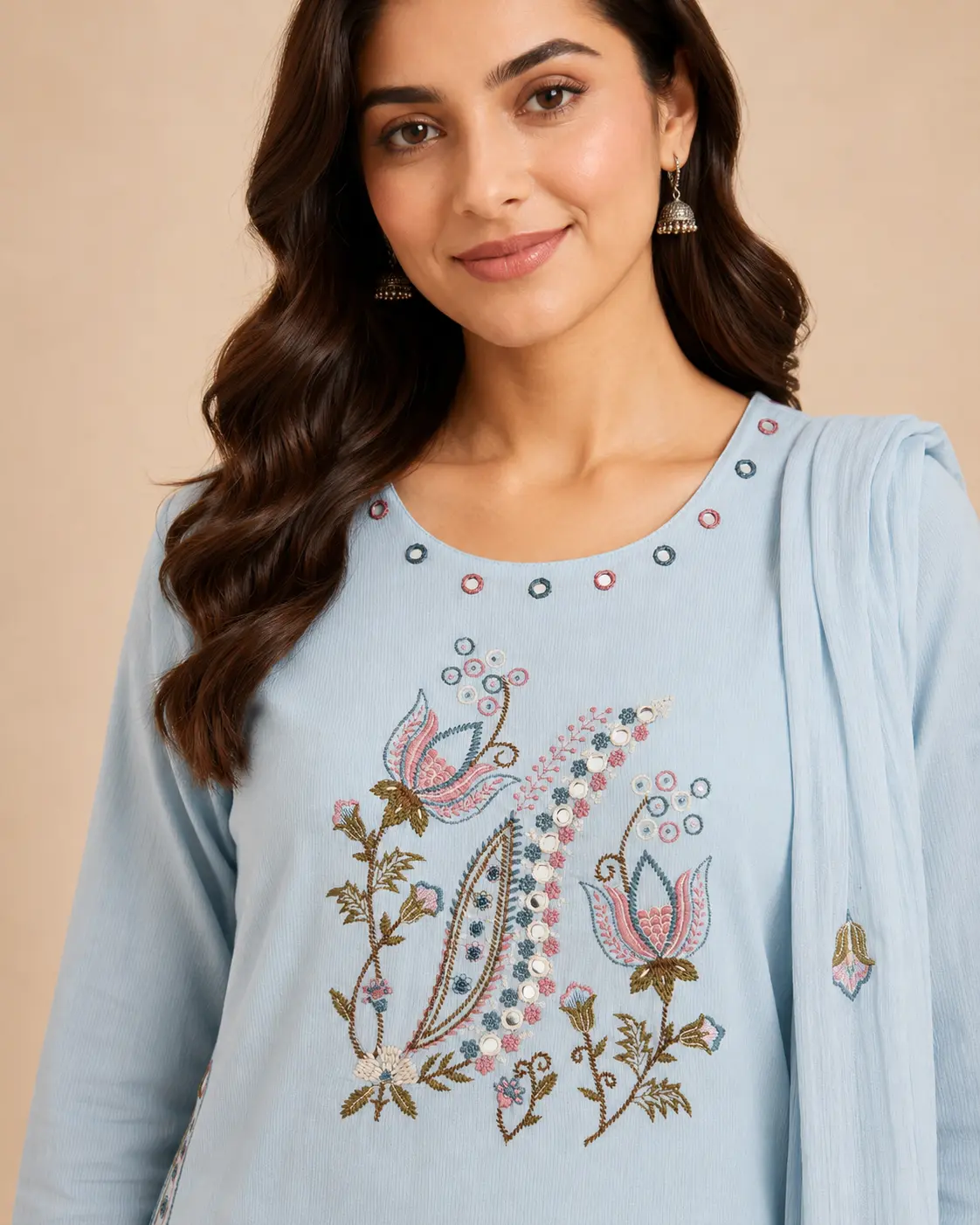
For Inara Ethnic’s professional-dressing approach, embroidery is best treated as part of an outfit’s structure and personality. It can create a focal point, frame a neckline or give a familiar silhouette a distinctive finish. It does not need to compete with every accessory you own to be noticed.
Start with the setting, not a rule about embroidery
Workplaces differ. A creative studio, a client-facing office, a school, a corporate headquarters and a home office may all have different expectations. Even within one workplace, an ordinary day and a formal event can call for different levels of detail.
Think about the day’s activities. Will you be presenting, working closely at a desk, travelling between locations or attending a celebration? Your clothing should let you participate comfortably. An outfit that needs constant adjustment may distract you even if it looks appropriate in a photograph.
If there is an explicit dress code, use it as your starting point. Otherwise, observe the general level of formality and choose an interpretation that feels authentic to you. The aim is not to erase personal style, but to make it easy to wear in the setting.
Polished does not mean plain
There is no requirement to remove all decoration from professional clothing. A clean embroidered neckline, a restrained sleeve detail or a carefully balanced motif can add interest while preserving a clear overall look.
Equally, more embroidery does not automatically mean a more premium garment. Quality involves execution, finishing, construction and suitability, not just the amount of work visible. A smaller well-integrated detail may serve your wardrobe better than an elaborate design you rarely wear.
If you are building a workwear wardrobe, begin with the level of detail you enjoy repeating. An outfit does not need to be saved for a special meeting simply because it has embroidery.
Look at scale and density together
Scale describes how large the motifs are. Density describes how closely they are arranged and how much of the garment they cover. These two features affect the visual impression differently, so assess both.
A single large motif can feel calm when surrounded by clear space. Many small motifs can create a busy effect if they cover the whole garment. Neither is inherently unsuitable for work, but the distinction helps explain why two embroidered sets may feel very different.
Stand back from the image as well as looking closely. The close-up tells you about detail; the full-length view tells you how that detail reads as an outfit. A useful design should make sense at both distances.
Use visual breathing room
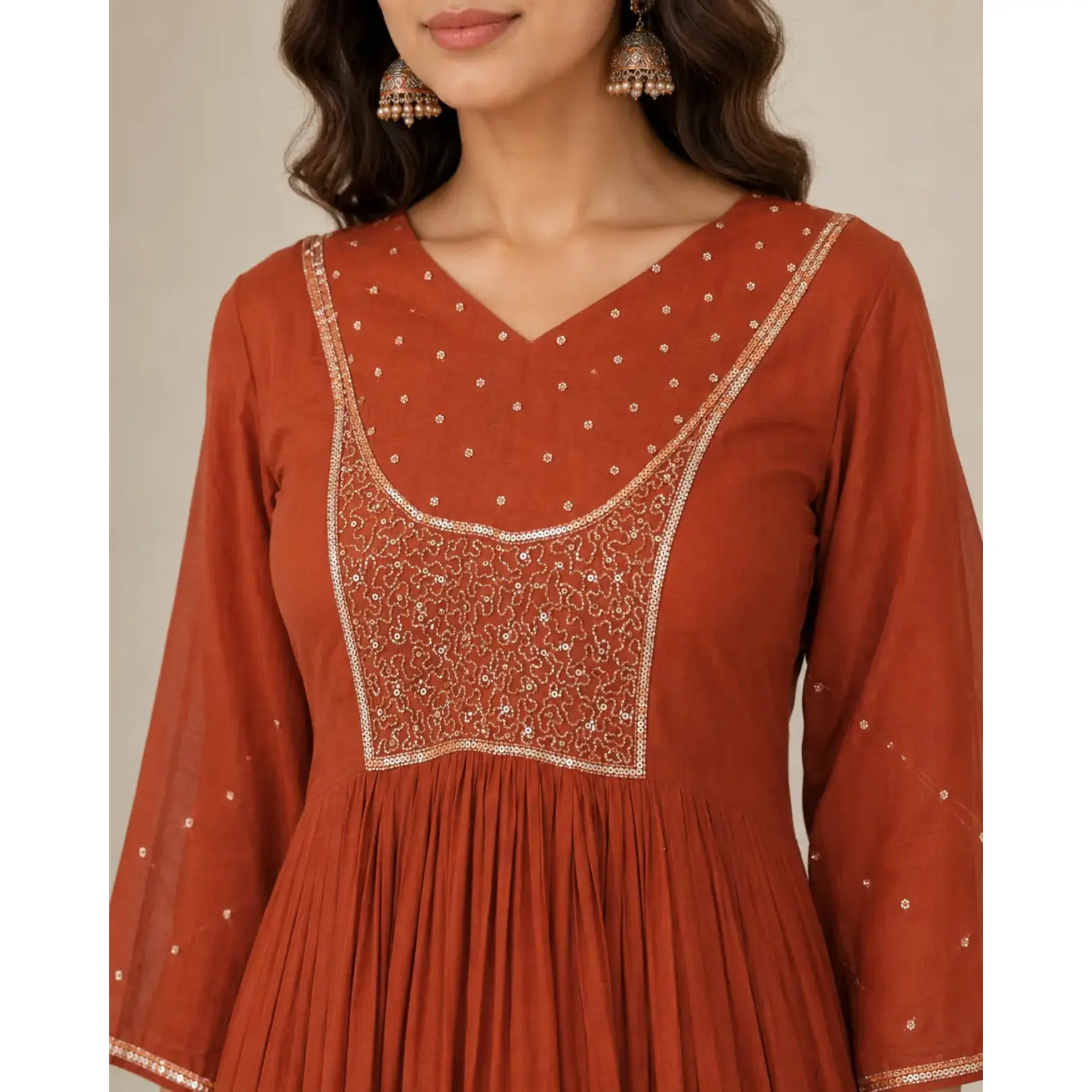
Areas without decoration allow the eye to understand the garment’s shape. If a kurta has an embroidered neckline, quieter fabric through the body may keep the look balanced. If the hem has a substantial border, restrained sleeves can prevent every edge from competing.
This is a styling principle, not a strict formula. Some all-over designs are beautifully coherent. The question is whether the motifs, colour and silhouette work together or whether the outfit feels more visually active than you want for the day.
When comparing products, ask where your attention goes first. If you cannot identify a clear focal point, you may prefer simpler accessories or a different garment for a more formal setting.
Do not judge only from a close-up
A macro photograph can make a small detail seem much more dominant than it is in real life. Conversely, a distant model photograph may hide a dense or shiny surface. Look for both views before deciding whether a design is understated.
Check the scale against the garment rather than estimating from the image dimensions. A border occupying a small part of a full-length view may be easy to wear daily even if its close-up looks intricate.
If the website provides only one view, ask for more information. It is better to understand the detail before ordering than to discover that the overall effect differs from what you imagined.
Choose placement that works with your routine
Neckline embroidery
Neckline work is a natural focal point because it sits near the face. It can give a simple straight or A-line kurta enough interest that little additional jewellery is needed. For work, consider whether the detail stays comfortable when you move and whether the neckline itself suits your preference.
Inspect the inside finish if information is available. Surface beauty and wearing comfort are different questions. A decorated area can feel different against the skin depending on backing, lining and construction.
Also look at fastening access. A narrow opening, decorative placket or heavily worked edge may affect how easily the garment goes on. Do not assume the design will behave like another kurta simply because the neckline looks similar.
Sleeve and cuff embroidery
Sleeve details are visible while you gesture or work at a desk. They can be an elegant way to introduce embroidery without covering the whole kurta. But the location needs to suit your movements.
If you type frequently, write by hand or work with materials, consider whether a raised cuff detail will brush against surfaces. Check sleeve length and opening. A firm embroidered cuff may not be easy to push up, even when the rest of the sleeve is roomy.
You do not have to avoid decorative sleeves. Simply choose them with your work routine in mind, just as you would choose footwear for the amount of walking in your day.
Hem borders
A hem border can ground the silhouette and make a simple upper section feel complete. Its visual effect depends on width, contrast and the kurta’s length. A narrow tonal border is different from a broad metallic one.
Check whether the border affects alteration options. Shortening a garment with detailed work at the hem may require more thought than shortening a plain edge. If length is important to you, confirm it before buying rather than assuming the border can be moved easily.
Look at the border with the supplied bottoms. A detailed kurta hem and equally detailed trouser hem may be intentional, but you should see how the combination reads in a complete outfit.
All-over work and scattered motifs
All-over embroidery can create texture rather than obvious ornament when the thread and base are close in colour. Scattered motifs may feel quieter because the background remains visible. Yet strong contrast or reflective elements can change that impression.
Assess the front, back and sleeves where images are available. A front-only view may not show the full amount of decoration. Ask whether the work continues around the garment if that matters to your decision.
Choose based on the complete design, not the assumption that scattered always means subtle or all-over always means festive.
Colour contrast and shine can matter more than quantity
Tonal embroidery uses colours close to the base fabric, while contrast embroidery separates the motif more clearly from the background. A small high-contrast detail may be more noticeable than a larger tonal area.
For a quieter workday look, you might choose a restrained contrast palette or let one accent colour provide interest. For a celebration or networking event, a stronger contrast may feel appropriate. Both can remain coherent when the rest of the outfit is considered.
Do not treat dark colours as automatically formal or light colours as automatically casual. Fabric, finish, fit and styling all contribute to the impression. The same colour can appear very different across different garments.
Assess reflective elements in context
Metallic-looking threads, sequins or other reflective details can change with lighting. A studio image may emphasise or soften that effect. If you want a restrained result, look for additional photographs or ask how the detail appears in ordinary light.
Use accurate product terminology. Do not assume that every gold-coloured detail is zari, or that every textured motif is hand embroidery. The product description should identify the work where known.
A little shine can be effective for work celebrations without becoming bridal. The balance depends on how many reflective elements appear across the kurta, dupatta, jewellery, bag and footwear together.
Let one accent connect the outfit
If the embroidery includes a distinct accent colour, you can echo it subtly in one accessory. That might be a small earring detail or a bag you already own. You do not need to match every item exactly.
Alternatively, let the garment carry the colour and keep accessories neutral. This can be especially useful when the embroidery uses several shades. A coordinated outfit does not have to be an exact colour-matching exercise.
For a fuller approach to choosing palettes, read our guide to colours in an Indian workwear wardrobe.
Check how embroidery works with the fabric
Embroidery is part of the garment, not a separate decoration floating on top of it. The base fabric, backing, lining and placement affect how the finished piece hangs and feels. A richly worked area may behave differently from the surrounding fabric.
Look for a smooth, coherent fall in natural views. Persistent puckering or pulling deserves clarification, although photographs alone may not establish the cause. It could involve the garment, the pose or the way it has been arranged.
Read component details separately. A set may have one fabric for the kurta, another for the bottoms and another for the dupatta. Embroidery on the dupatta does not tell you anything about the kurta’s composition or lining.
Do not confuse decorative detail with quality evidence
Words such as premium, intricate and luxurious describe an impression, but they are not enough to evaluate construction. Clear close-ups, accurate material information and consistent finishing provide more useful evidence.
Look at the neckline edge, seams, sleeve finish and any visible backing. Ask about care instructions. A garment that requires a care routine you cannot realistically follow may not be the best daily workwear choice, however appealing the detail.
Handmade claims should be supported by the seller’s information, not inferred from the appearance of embroidery. Machine embroidery can also be beautifully executed. The useful distinction is accurate description and good finish, not an unsupported hierarchy.
Fit still comes first
Embroidery should not be under strain when you move. If the kurta pulls across the bust or arms, the detail may appear distorted and the outfit may feel uncomfortable. Do not size down simply to make the silhouette look neater in a photograph.
Check the product-specific chart and the intended cut. A relaxed straight kurta and a fitted upper section require different assessments. More fabric at the hem does not establish comfort through the shoulders or sleeves.
Our ready-to-wear fit guide explains the measurements and movement checks that should sit alongside your design choice.
Build the outfit around one main point of interest
If embroidery is the feature you love, give it room to be seen. That may mean simpler jewellery, a less patterned bag or a quieter dupatta drape. Removing competing details can make the embroidery feel more considered without reducing its character.
Start by putting on the complete set, then add accessories one at a time. Ask whether each addition contributes something useful. A necklace may not be needed when the neckline already has detail. Large earrings may compete with an ornate collar, while smaller ones may support it.
This is not a rule that you must wear minimal jewellery. It is a method for understanding the balance before deciding how expressive you want the final look to be.
Jewellery
For a busy neckline, consider earrings rather than a necklace. For a quieter neckline and detailed hem, a small necklace may work if you enjoy it. Choose pieces that are comfortable for the length of your day.
Avoid making claims about the weight or comfort of jewellery based on a styled photograph. Accessories in editorial images may not be sold with the outfit. Check what is included and choose your own pieces according to their actual characteristics.
If you wear a watch, think about how it sits beside an embroidered cuff. You may prefer a simpler wrist arrangement so that the two do not catch or crowd each other.
Footwear and bag
Choose footwear for the amount of walking and standing you expect, then consider its visual relationship with the suit. A simple shoe can provide a quiet base for detailed clothing without needing to disappear completely.
The same applies to a bag. A practical structured or softly shaped bag can work, depending on the outfit and your needs. Consider strap placement near raised embroidery and whether the bag rubs against the area while commuting.
You do not need a new accessory for every suit set. Repeating a small group of reliable items can make your wardrobe feel coherent and reduce morning decisions.
Dupatta and hair
A dupatta can frame the embroidery or conceal it. Try a drape that keeps the main detail visible while remaining manageable. If the dupatta itself is richly decorated, you may choose to let it become the focal point instead.
Hair can also change how the upper details read. Wear it in a way that feels comfortable and suited to your day; there is no single professional hairstyle. The practical aim is simply to prevent constant interference with a neckline or accessory if that bothers you.
For a change after work, you can adjust the drape or one accessory rather than rebuilding the entire outfit. Our office-to-dinner guide offers a more detailed approach.
Match the level of detail to the occasion
An ordinary office day
Choose the embroidery level you are happy to repeat regularly. A defined neckline, small motifs or a quiet border may provide enough interest. Check that the sleeves and fabric suit your actual tasks.
Do not save every attractive garment for an imagined future event. If the set fits, is practical to care for and feels right at work, it can become part of your normal rotation.
An important meeting
For a more formal meeting, aim for a coherent overall outline. You may prefer controlled contrast and one main decorative area so that the outfit feels settled rather than busy.
Test it while sitting and gesturing. A design that distracts you through pulling, slipping or catching is less useful than one you can wear naturally. Clothing does not create expertise, but it can support your comfort while you bring your expertise to the room.
A networking event
A slightly more expressive detail can feel natural at a networking event, especially when the setting is social as well as professional. Consider a distinctive neckline or a richer colour rather than assuming you need more decoration everywhere.
Remember the practical side: standing, greeting people, holding a drink and carrying essentials. Keep the outfit manageable enough that you can concentrate on conversations.
An office celebration
This may be the right occasion for more visible embroidery or a touch of shine. Keep the complete outfit in view. A detailed suit, heavily bordered dupatta and several statement accessories together may create a stronger festive effect than you intended.
You can choose one or two expressive elements and keep the others quiet. The result can feel celebratory without imitating bridal styling.
Questions to ask before buying an embroidered set
- What work is actually described, and is the terminology clear?
- Where does the embroidery appear: front, back, sleeves, hem or dupatta?
- Are there close-ups as well as full-length views?
- Does the chart provide enough information for comfortable fit?
- Is the embroidered area lined or otherwise finished inside?
- What are the care instructions for each component?
- Will the sleeve and hem details work with my routine?
- Do the accessories shown come with the set?
Not every listing will answer every question. The important step is to identify which missing detail affects your purchase. If sleeve comfort matters because you work at a desk all day, ask about that specifically rather than seeking a general assurance that the garment is comfortable.
When considering an Inara Ethnic set, contact us with the product name and the detail you want clarified. Accurate information should come before a decision based only on the word premium.
How to make a small embroidered wardrobe feel varied
You do not need every set to have a different level of ornament. Variety can come from placement, colour, silhouette and styling. One neckline-focused set, one with restrained scattered work and one with a distinctive border can create different impressions without leaving your preferred workwear style.
Build around clothes you already enjoy. If you repeatedly choose straight cuts and quiet colours, a slightly richer embroidered version may be more useful than a dramatically different set that does not fit your routine.
Keep a note of what works after wearing an outfit. Did the cuff remain comfortable? Did the dupatta stay manageable? Did you enjoy the amount of detail in an ordinary setting? Those observations are more valuable than a rule based on trends alone.
Four ways to compare two similar embroidered suits
Compare them at the same distance
Place the full-length views beside each other, then compare their close-ups separately. This prevents one product’s dramatic detail photograph from dominating your judgement. Notice the proportion of decorated fabric, the clarity of the overall outline and how much contrast appears near the face.
Then ask which one suits the occasion you are buying for. You may love both, but one may be easier for a regular office day while the other feels more natural for a work celebration. Naming that difference helps you buy with purpose rather than simply choosing the most visually striking image.
Compare the components
Look beyond the kurta. One set may have a quiet dupatta and detailed sleeves; another may have a simple top with a stronger dupatta border. The complete combinations can feel different even when the kurta colour is similar.
Check the bottoms too. A decorated ankle or a contrasting fabric adds another point of interest. Decide whether you enjoy the total effect and whether the components can be worn comfortably together in your actual setting.
Compare care requirements
A workwear purchase should fit your care routine. Read the stated cleaning and pressing guidance rather than assuming all embroidered cotton or all festive-looking fabrics can be treated the same way. Mixed components may require different attention.
If the care information is absent, ask before ordering. Avoid experimenting with heat or washing methods based on an online styling article. The garment’s own instructions and the maker’s clarification take priority over general advice.
Compare likely repeat wear
Think of three realistic occasions when you would choose each set. These can be ordinary workdays, a meeting and dinner, not necessarily three major events. If you cannot imagine wearing one beyond a single photograph, consider whether that matches your purpose.
This is not a rule against special purchases. It is a way to distinguish a wardrobe staple from an occasion-led choice. Both can be worthwhile when you know what role they are meant to play.
Care habits that protect the detail without making promises
Follow the care label and any garment-specific guidance supplied by the seller. Embroidery, backing, trims and the base fabric may respond differently to cleaning or heat. A generic instruction for one fabric should not override the actual set’s requirements.
Before wearing, check for anything that may catch against the work: a rough bag strap, a sharp jewellery edge or a fastening on an outer layer. You cannot eliminate every source of wear, but noticing these points can help you handle the garment more thoughtfully.
Store the set in a way that avoids unnecessary pressure or catching on neighbouring clothes, according to the garment’s needs. If you use hangers, consider whether the construction is suitable for hanging. If folding, avoid creating repeated strain across a heavily decorated area.
Do not promise yourself that careful handling will make any garment last a fixed number of years. Durability depends on materials, construction, use and care. The sensible aim is to follow verified instructions and respond to the condition of the actual garment.
A small exercise before you decide
Imagine the suit with only your usual shoes and bag. Does it already feel complete? If yes, the embroidery is probably doing the amount of visual work you want. If you feel compelled to add several new accessories, pause and ask whether the garment fits your wardrobe or only an imagined styling scene.
Next, picture the most ordinary part of your day in it: typing, commuting, walking to lunch or sitting in a meeting. That exercise brings the decision back to usefulness. A premium impression should not depend on an outfit being comfortable only while standing still.
Finally, identify the detail you genuinely love. It might be the sleeve motif, the tone of the thread or the clean space around a neckline. Buying for a specific, understood feature is usually a stronger decision than buying because a caption calls the set luxurious.
Frequently asked questions
How much embroidery is too much for work?
There is no universal limit. Consider the workplace, occasion, density, contrast and the whole outfit. A quiet all-over design may feel less conspicuous than a small highly reflective motif. Assess the complete look rather than counting decorative elements.
Is tonal embroidery always the safest choice?
It can be a useful starting point if you prefer a restrained effect, but it is not the only option. A carefully chosen contrast colour can also look polished. The garment’s cut, finish and your accessories influence the result.
Can I wear zari work to the office?
It depends on the actual design and your setting. Check the amount, placement and reflectivity rather than assuming the label decides suitability. Use the seller’s description to confirm the work instead of identifying it solely from a photograph.
Should I avoid necklaces with embroidered necklines?
Not necessarily, but try the outfit without one first. The neckline may already provide the focal point you want. Add a necklace only if it improves the balance and remains comfortable rather than because the outfit feels incomplete without every accessory.
Does more embroidery mean better value?
No. Value also depends on accurate materials, construction, finishing, fit, care needs and how often you will wear the garment. A heavily worked set that stays in the wardrobe may be less useful to you than a simpler one you enjoy regularly.
Can embroidery be altered or moved?
Sometimes, but it depends on the construction. Borders, panels and worked cuffs can limit straightforward alterations. Ask a competent tailor about the actual garment and check return conditions before making changes.
When in doubt, choose the version you can explain clearly to yourself: the colour works with your wardrobe, the placement suits your activities and the finish is supported by useful information. That is a more dependable decision than following a blanket rule about how much embroidery a professional woman should wear.
Let detail support your personal style
The most useful embroidered workwear feels deliberate rather than overloaded. It gives you something to enjoy in the outfit while leaving enough clarity for the silhouette, colour and your own presence.
Choose the detail in context, confirm the fit and keep styling practical. When embroidery works with your routine instead of competing with it, it becomes a natural part of professional dressing rather than something reserved only for special occasions.
