An office celebration asks for a slightly different kind of dressing from either an ordinary workday or a family wedding. You may want colour, embroidery and a sense of occasion, while still feeling comfortable around colleagues, moving through the workplace and returning to normal tasks afterwards. The challenge is not to look less festive. It is to choose which festive elements belong in that setting.
A considered suit set can make that balance easier. Begin with the event’s dress expectations, choose one clear focal point, and keep the rest of the look comfortable and intentional. A detailed neckline, a richer colour or an expressive dupatta may be enough. You do not need every festive element at once to look appropriately dressed.
This guide is for workplace festivities, team lunches, annual events and celebrations that connect a working day with an evening gathering. It is not a set of restrictions on how women should dress. Your organisation, your role, the venue and your own preferences matter more than a generic rule about what is too much.

First, find out what kind of celebration it is
An office lunch during working hours is not the same as a formal evening event at a hotel. Start with the invitation or internal message. Is there a dress code, a colour theme or a request for traditional clothing? Does the event involve a ceremony, a meal, performances or informal conversation? These details tell you more than the word celebration alone.
If the message is unclear, ask the organiser one practical question: how dressed up are people expected to be? You do not need to seek permission for every outfit choice. You simply need enough context to make a comfortable decision. Photographs from previous events may help, but remember that the venue and format can change.
Consider whether clients or external guests will attend. That may influence how closely you want to stay to the organisation’s usual professional style. It does not mean ethnic wear must be plain. A well-chosen embroidered set can still feel formal when its proportions, finish and accessories are considered together.
Also check whether you will work before or after the event. If the celebration is one part of a full office day, choose an outfit that supports both. If you have time to go home and change, you can treat the evening as a separate occasion rather than trying to make one look perform every role.
Think about your part in the event
You may be attending quietly, hosting guests, presenting awards, helping with arrangements or spending much of the event standing. Each role changes the practical demands on clothing. Someone moving chairs and carrying materials may want a different sleeve or dupatta arrangement from someone seated for a formal dinner.
Imagine the movements you will actually make. Will you climb steps onto a stage, lean forward to greet people, use a microphone or hold a plate while talking? Check that the outfit lets you do those things without repeated adjustment. That is a more useful test than whether the look seems sufficiently festive in a still photograph.
If a badge or lanyard is required, see how it sits against the neckline and embroidery. Avoid placing it where it catches delicate work. If you need to carry work equipment, test the bag with the outfit. A decorative sleeve that repeatedly catches under a strap can become frustrating over several hours.
There is no need to make the outfit overly functional or severe. The aim is to remove small distractions so you can enjoy the event. Clothing that supports your role often looks more assured because you are able to move naturally in it.
Choose one main festive focal point
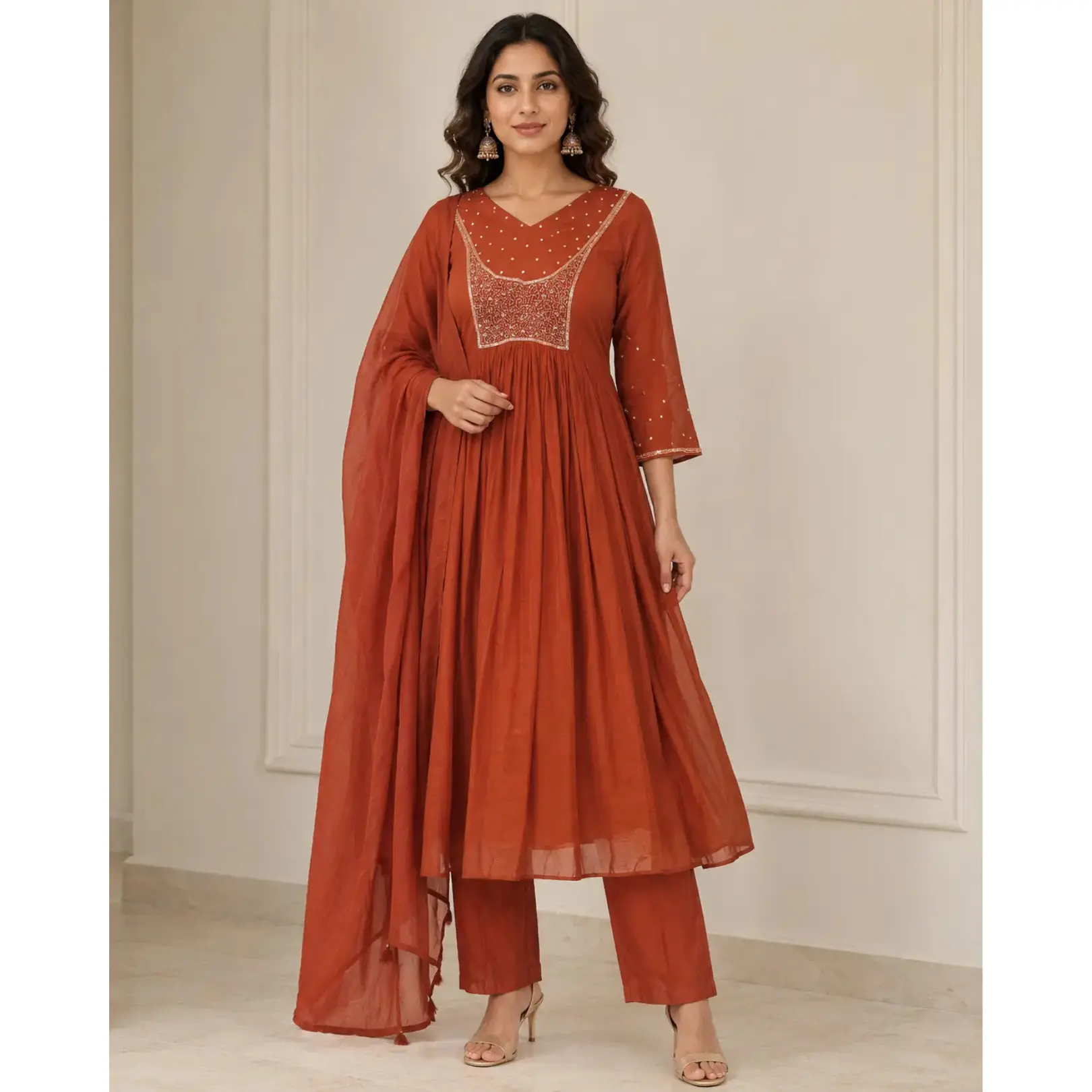
A focal point gives the eye somewhere to settle. It might be a beautifully worked neckline, a rich colour, a contrasting dupatta or a distinctive silhouette. Once you have chosen that element, let the rest of the styling support it. This is a useful way to create a festive impression without automatically adding more decoration.
For example, a kurta with concentrated embroidery near the face may not need a necklace. A bold dupatta can be paired with quieter earrings. A rich, mostly unbroken colour can feel complete with an understated bag and footwear. These are styling options, not rules; the important point is that the elements work together rather than compete.
Look at the outfit from a few steps away. Details that seem separate close up may combine into a much busier impression at normal conversational distance. If you are unsure, remove one accessory and compare. Often the garment becomes more visible when it has a little space around it.
Restrained styling is not the same as being underdressed. It can make embroidery, colour and fabric appear more deliberate. The question is not how many festive items you can add, but which ones make the outfit feel most like you in this particular setting.
Use colour as an alternative to heavy embellishment
Colour can provide the sense of occasion even when the embroidery is subtle. A deeper blue, expressive pink, warm rust or soft green may feel celebratory depending on the fabric and styling. Equally, a neutral outfit can look festive through texture and a contrasting accessory. There is no single palette that works for every office celebration.
Start with colours you enjoy wearing near your face. Then consider the venue and time of day. A shade may look different in daylight, warm indoor lighting and flash photography. Check the complete outfit in more than one setting if possible, especially when the colour is the main reason you are choosing it.
Do not use skin tone as a set of prohibitions. Personal preference, contrast, makeup and the rest of the outfit all affect how a colour feels. A colour guide should expand your options, not tell you that certain women must avoid particular shades.
If you are building an outfit around an existing bag or pair of shoes, place them beside the suit before making a decision. A small accent in the embroidery can connect the pieces without an exact match. For a broader approach, see the guide to a polished workwear colour palette.
Choose a silhouette you can enjoy wearing
Straight, A-line and fuller silhouettes can all work for office occasions. What matters is the particular garment and the event. A straight suit may feel easy for a lunch followed by work. An A-line set can offer a different sense of movement. A fuller shape may suit an evening celebration when you have more room and time to manage it.
Check the amount of fabric around the lower body, the length of the kurta and the way the bottoms sit with your shoes. An outfit that pools on the floor or catches as you walk can be difficult in a busy workplace. A photograph may hide these practical details, so rely on actual measurements and a movement check rather than appearance alone.
A more fitted look is not inherently more professional, and a looser shape is not automatically casual. Fit should allow comfortable sitting, breathing and movement while maintaining the intended silhouette. Pulling across the shoulders or hips can distract from even the most beautiful embroidery.
If you are deciding between shapes, the straight, A-line and Anarkali guide explains what to compare. Choose the shape that suits your day and preferences rather than trying to follow an abstract rule about what an occasion outfit should be.
Read embroidery by placement, scale and finish
Embroidery is not simply a choice between plain and heavy. Placement makes a difference. Concentrated work at the neckline can draw attention upward; a border can define the hem; scattered motifs can create texture across the garment. Consider how these details look together and whether the styling leaves them visible.
Scale matters too. A large motif may be striking without covering much fabric, while fine repeated work may create a richer overall surface. Neither is automatically more suitable for work. The best choice depends on the event, the garment’s colour and the other elements you plan to wear.
Look at close-up images when buying online, but do not infer construction methods from appearance. A design can look intricate without being handmade, and a general term such as premium does not explain the technique. Use the supplied product details and ask for clarification if the type of work matters to your decision.
For styling, notice whether an accessory sits over the embroidery or catches it. A necklace may obscure the detail you liked most, while a textured bag strap can rub against it. The office-wear embroidery guide offers a more detailed framework for choosing decorative work without overwhelming the outfit.
Check the fabric and lining, not just the surface
A festive-looking surface does not tell you how an outfit will feel through a long event. Read the fabric details for each component separately. The kurta, bottoms and dupatta may use different materials, and a lining can change the weight or feel of the finished garment. Avoid assuming that a light-looking photograph means the set will feel equally light when worn.
Consider the room temperature and your expected activity. An air-conditioned evening venue and a daytime outdoor gathering may call for different choices. Your own comfort with a fabric matters. A set you have already worn comfortably can be a dependable option when you do not want to experiment on an important day.
Check opacity in normal light with the underlayers you intend to wear. A styled product photograph is not a substitute for clear lining information or a personal fit assessment. If you are buying for a specific date, leave enough time to receive, inspect and try the outfit.
Care requirements are part of the decision as well. A garment that needs specialist preparation may be perfectly suitable, but that preparation should be planned. Do not discover on the morning of the event that the outfit cannot be treated with the method you normally use.
Let the dupatta add occasion without adding difficulty
The dupatta can be the easiest way to move a suit set from everyday to celebratory. A different drape may reveal a border, bring colour near the face or make the outfit feel more complete. Start by trying it with the garment rather than deciding on a drape in isolation.
For a seated lunch, check that the fabric stays clear of the table and feels comfortable when you move your arms. For a standing event, consider whether you will be holding a drink, a plate or your phone. A drape that leaves your hands free may be more useful than one that needs constant attention.
If you secure the fabric, choose a method appropriate to it and avoid damaging delicate embroidery. Do not force a pin through an area simply to copy a photograph. A simpler drape can be equally elegant and much easier to manage throughout an event.
Try the dupatta with jewellery and the bag strap together. Pieces that look lovely separately can catch against one another. That small check can prevent a recurring irritation later. The best styling is the version that remains comfortable after you have stopped looking in the mirror.
Keep jewellery in conversation with the neckline
Begin with the neckline before choosing jewellery. If the kurta already has detailed work near the face, earrings alone may be enough. If the neckline is quiet, you may prefer a delicate necklace or another focal piece. You are not required to wear a full matching set to make an outfit feel festive.
Check the scale of the earrings with the hairstyle and dupatta. A piece can look balanced with hair tied back and feel busier with a detailed border beside the face. Move your head and see whether the earring catches the fabric. Comfort and secure fastening matter as much as the front view.
A watch or a small bracelet may suit a workplace event better than several pieces that interfere with typing or serving food, depending on your activities. Avoid stacking accessories automatically. Choose the ones you actually enjoy wearing for the length of the event.
Keep styling descriptions honest when shopping. Jewellery shown in a product photograph may not be part of the suit set. Read the included-components list and budget for accessories only if you need them. Often an existing favourite is the most natural finishing touch.
Choose shoes and a bag that complete the practical plan
Your shoes need to work with both the outfit and the venue. Think about standing time, stairs and any walking between the office and the celebration. A familiar pair can be a better choice than a decorative new pair you have not worn before. There is no rule that a festive outfit requires a high heel.
Check the bottom hem with the exact shoes you intend to use. A change in height can alter how the fabric falls and whether it catches underfoot. If you plan to change shoes for the evening, test both pairs before the day of the event. The garment should remain manageable in each version.
The bag should hold what you genuinely need. If the celebration follows work, you may still be carrying a laptop or documents. A smaller evening bag is optional, not a requirement. You can choose a neat work bag that coordinates with the outfit rather than carrying two bags simply for appearance.
Look at the finish of the shoes, bag and jewellery together. They do not need to match exactly, but they should feel intentional. A quiet accessory can be particularly useful when the suit’s colour or embroidery is already doing the visual work.
Makeup and hair should support the look, not become a costume
You can make a celebration outfit feel different with a small change to your usual grooming. That might be a slightly more defined eye, a lip colour you enjoy or a hairstyle that shows the neckline. The aim is to feel comfortable and recognisable, not to meet a fixed standard of how festive makeup must look.
Choose products and techniques you know work for you, especially if you will be wearing them through a full workday. An event is not the ideal time to experiment with something that may feel uncomfortable or require frequent attention. Keep any touch-up items proportionate to what you normally use.
Think about hair in relation to the garment. A detailed back or neckline may be more visible with hair arranged away from it, but that is an option rather than a duty. Make sure the style feels comfortable when you sit, move or wear a layer.
Do a final check in ordinary light. Event photographs may be part of the day, but the outfit should work in person first. You should not have to hold a specific pose or expression to feel that the look is complete.
Outfit plan one: a daytime celebration at the office
For a celebration held during the working day, begin with a suit you could reasonably continue working in. Add one occasion detail: a richer dupatta, a slightly more expressive earring or a colour that feels special to you. Keep footwear comfortable enough for your normal route through the office.
Suppose the kurta has subtle embroidery and the dupatta carries more colour. Let the dupatta be the focal point, keep jewellery light and choose a bag you already use. You have created a festive change without making the rest of the day difficult. If the garment itself is more detailed, simplify the accessory choices instead.
Check whether the celebration involves food, shared activities or sitting on different types of seating. A drape that works at your desk may need a small adjustment for the event. Choose the practical version before leaving home rather than planning to solve it once you arrive.
This approach suits someone who wants to participate fully without feeling dressed for a different occasion. It also makes the outfit easier to wear again. The celebration is expressed through a few considered choices rather than an entirely separate wardrobe.
Outfit plan two: a formal evening organised by work
An evening event may allow a richer fabric appearance, a deeper colour or more noticeable embroidery, depending on the invitation. Start with the suit rather than accessories. Decide what makes the garment special, and give that element space in the overall look.
If the embroidery is intricate, a restrained earring and a simple bag may be enough. If the suit is quiet, you might choose a more expressive dupatta or jewellery. Try both possibilities and see which feels appropriate to the venue and your own style. More decoration is not automatically more formal.
Consider the journey home and any time you will spend standing. A polished evening look still needs to be comfortable after the first photographs. Secure fastenings, a manageable hem and footwear you can use confidently are practical parts of the styling, not compromises.
If you are coming directly from the office, keep the change simple and realistic. The office-to-dinner guide can help you plan a version that needs only a few adjustments. If a full change is more comfortable, give yourself enough time to do it without rushing.
Outfit plan three: a themed or traditional-dress day
A theme can make choosing easier, but it should not force you into buying an outfit you will never wear again. Read the brief carefully. A colour theme may be satisfied by one component or accessory, while a request for traditional clothing may leave plenty of room for your usual personal style.
Look in your wardrobe first. An existing suit might work with a different dupatta or a small styling adjustment. If you do need something new, choose a piece that also fits your life beyond the event. Think about ordinary workdays, family lunches or other occasions where you would enjoy wearing it.
If the theme is unfamiliar or could be interpreted in different ways, ask the organiser for clarification. Avoid treating cultural clothing as a costume or relying on caricatured styling. A respectful, comfortable interpretation is more useful than an exaggerated one.
Keep the workplace context in mind without losing the enjoyment of the event. The theme is a starting point, not a demand to abandon your own preferences. You can participate thoughtfully while still feeling like yourself.
Use photographs as a check, not as the only goal
A quick phone photograph can help you see the whole outfit more objectively. Take one from the front and one from the side in normal light. Look at the balance of colour, the position of the dupatta and whether an accessory hides the detail you wanted to show. You do not need a professional setup for this check.
Also look without the camera. Move around, sit down and notice how the outfit feels. A garment can photograph beautifully while requiring constant adjustment, and a comfortable look can feel better in person than a single still image suggests. Both perspectives matter.
Do not assume that a model photograph predicts your exact fit or proportions. The model’s height, the sample size, styling and pose can affect the appearance. Use the product’s stated measurements and your own assessment to decide where the hem, neckline and sleeves will sit.
If an image appears to show an accessory or component that is not listed, ask rather than assume. Clear information is part of a confident purchase. A celebration outfit should be chosen with enough time to resolve those questions, not only because the photograph creates urgency.
Plan the second wear before buying the first
A useful occasion purchase has somewhere to go after the celebration. Before ordering, think of two other situations where you could wear the set. Perhaps the kurta would suit a work lunch with quieter accessories, or the full outfit could work for a family gathering. This simple exercise helps separate a genuine wardrobe addition from a one-event impulse.
Rewearing does not require turning every set into many unrelated combinations. Wearing the same complete outfit again is perfectly reasonable. A different earring, hairstyle or dupatta arrangement may change the mood, but you do not need to disguise repetition to enjoy a purchase.
If you want to mix components, check colour, proportions and fabric appearance together. A bottom from one set may not automatically suit another kurta, even if the colour names match. Test the combination rather than relying on the idea of versatility in the abstract.
Care is part of rewearing. Follow the garment’s instructions after the event and store it in a way that protects the embroidery. An outfit that fits your practical routine is more likely to become something you reach for, rather than something that remains packed away.
Avoid the common mistakes that make the look feel overworked
The first is adding a statement element at every point: detailed neckline, large earrings, necklace, decorative bag, strong footwear and an elaborate drape. Any of these can be lovely, but together they may hide the suit itself. Try removing one or two and see whether the outfit becomes clearer.
The second is ignoring the working part of the day. An outfit that feels perfect for a short evening photograph may not suit hours at a desk or a busy commute. Plan the actual sequence of events and choose the version that works through it.
The third is buying too close to the occasion. A new suit may need a fit check, clarification or preparation, and the seller’s delivery estimate is not a guarantee for your specific event. Leave time for inspection and keep a familiar alternative available.
The fourth is treating expensive as a substitute for suitable. Price alone cannot tell you whether the set fits, whether you like the fabric or whether it works for the occasion. Specific details, a comfortable fit and thoughtful styling are more useful than a label or a dramatic discount.
A final checklist before you leave
- The outfit suits the invitation, venue and your role.
- You can sit, walk, reach and greet people comfortably.
- The kurta and bottom lengths work with the chosen footwear.
- The dupatta stays manageable with your bag and activities.
- Jewellery does not catch the embroidery or compete with every detail.
- Underlayers and lining provide the coverage you want.
- Any garment-care preparation follows the label.
- You have allowed enough time to dress without rushing.
- The look feels like you, rather than a costume for the occasion.
When exploring the Inara Ethnic collection, begin with the kind of celebration you actually attend. Read the individual set’s details and picture how it will work with pieces you already own. That makes it easier to choose something special without losing the practical elegance of your everyday wardrobe.
Frequently asked questions
Can a heavily embroidered suit work for an office celebration?
It can, depending on the event and workplace. Consider the invitation, venue, your role and how the garment feels when worn. Keep other styling elements quieter if the embroidery is the focal point. There is no universal amount of decoration that is right for every office.
Do I need to buy a new outfit for every work celebration?
No. An existing set can work well with a different drape or accessory, and repeating a complete outfit is also perfectly reasonable. Buy when the garment fills a genuine need and suits your preferences, not because repetition is something to hide.
Are flats appropriate with a festive suit set?
They can be. Choose footwear that suits the event, feels comfortable and works with the bottom’s length. The finish and condition of the shoes, along with the overall outfit, matter more than heel height alone. Test the complete look before the day.
How can I make a simple suit feel more festive?
Choose one clear change, such as a more expressive earring, a different dupatta arrangement or a colour accent. Check that it complements the garment rather than covering its details. You may find that a small adjustment creates enough distinction from your usual workday styling.
What should I do if I am unsure about the dress code?
Ask the organiser for a brief description of the expected level of formality. Use that information together with the venue and time of day. A considered question is more helpful than guessing and buying something you will not feel comfortable wearing.
Festive office dressing works best when it feels intentional and easy to inhabit. Choose the detail you love, give it space, and let the rest of the outfit help you enjoy the occasion.
