The best outfit for a networking event is one that helps you participate rather than one that makes you manage your clothes all evening. An elegant Indian suit set can do that beautifully: it can feel considered, expressive and appropriate while leaving room for conversation, movement and a long day. The aim is not to dress as formally as possible. It is to match the event, feel like yourself and arrive ready to meet people.
For most professional networking settings, begin with a well-fitting kurta or suit set, controlled detailing, footwear you can stand in and a bag that leaves your hands reasonably free. Then adjust the colour, embroidery and accessories to the venue and level of formality. A breakfast roundtable, an industry exhibition and a hotel reception do not need the same outfit, even if all three are described as networking.
This guide gives you a practical way to make those decisions. It is written for women who enjoy Indian workwear and want to look polished without borrowing the visual language of a wedding. It does not assume that confidence comes from wearing a particular colour, owning expensive clothes or following a strict body-type formula. Your outfit should support the work you are there to do.
1. Read the event, not just the invitation headline
Start with three questions: who is hosting, where is it taking place and what will you actually do? These tell you more than words such as exclusive, premium or professional. A trade association may host a relaxed café gathering or a formal awards reception. A technology conference can include seated presentations, a crowded exhibition floor and a dinner on the same day. Your clothing needs to work for the activities you plan to attend.
Check the invitation for a dress code and follow any explicit requirement first. When the language is unclear, look for practical details such as an outdoor venue, a standing reception, a stage appearance or a site visit. Photographs from a previous edition can offer context, but do not treat one person’s outfit as a compulsory standard. The goal is to understand the range of formality, not to copy a stranger.
Separate formality from festivity
A formal business event does not automatically call for heavily embellished clothing. Formality can come from a clean silhouette, a coherent colour palette, a well-finished appearance and purposeful accessories. Festivity often adds more sparkle, richer ornament or ceremonial styling. You can choose a refined embroidered set for a formal evening without styling it like occasion wear for a family celebration.
Conversely, a relaxed event does not mean you must abandon thoughtful dressing. A simple suit set can look entirely appropriate at a small founder meetup when paired with quiet footwear and minimal jewellery. It should feel approachable and practical rather than as though you are dressed for a presentation that nobody else knew about. When uncertain, make the foundation restrained and carry one optional accessory for a dressier finish.
Plan for the whole route
Your event begins before you reach the registration desk. Think through your commute, any office hours beforehand and the journey home. Will you walk from a station, sit in a car for an hour or carry a laptop? Will you move between an air-conditioned hall and a warm outdoor terrace? An outfit that only works in a posed photograph at the venue is not yet a complete plan.
Write down the longest and most demanding part of the day. If that is several hours of standing, footwear deserves early attention. If it is a presentation followed by informal introductions, check the neckline, microphone placement and ability to move your arms. If the event follows an ordinary workday, build on something you already know you can wear comfortably for several hours.
2. Build the outfit around fit and ease
A networking outfit should allow ordinary movements without repeated adjustment. Try sitting, standing, walking, reaching into your bag and turning to greet someone. Notice whether the shoulder seams pull, the neckline shifts, the sleeves catch or the bottoms restrict your stride. These observations matter more than whether the garment matches a fashionable label such as structured or relaxed.
Choose the amount of ease that feels comfortable on you. Too little can make you aware of every movement; too much can feel cumbersome if the garment repeatedly slips or gets in your way. There is no single measurement that makes a suit set professional. Compare the actual garment measurements with your needs and, when possible, with a similar outfit you already enjoy wearing.
Think about the kurta and bottoms separately
A set may be sold as one coordinated outfit, but each piece needs its own assessment. Check the kurta’s shoulder fit, armholes, sleeve opening, length and side slits. Then check the bottoms at the waist, seat, thigh and hem. A comfortable top does not compensate for a waistband that pinches when seated, and attractive trousers are less useful if their hem drags under your shoes.
When buying online, do not assume the size name tells the whole story. Look for whether the chart describes body or garment measurements, and confirm unclear details before ordering. If the event is close, leave realistic time for delivery, trying on and any alterations you choose to arrange. Avoid building the entire plan around an untested outfit arriving on the last possible day.
Choose a silhouette you can forget about
A straight kurta can offer a clear, simple line, while an A-line shape can provide a different sense of movement. A more flared silhouette may also work when its volume and length suit the venue and activity. None is inherently more professional or more suitable for a particular body. Consider how the actual garment behaves, not just the category name.
If you will circulate through a busy room, check that the hem does not catch underfoot and the sleeves do not sweep across shared tables. If you expect a seated discussion, try the outfit in a chair rather than judging only in the mirror. For a fuller foundation, use our guide to choosing a kurta set for the office before adding event-specific details.
3. Let one element provide the visual interest
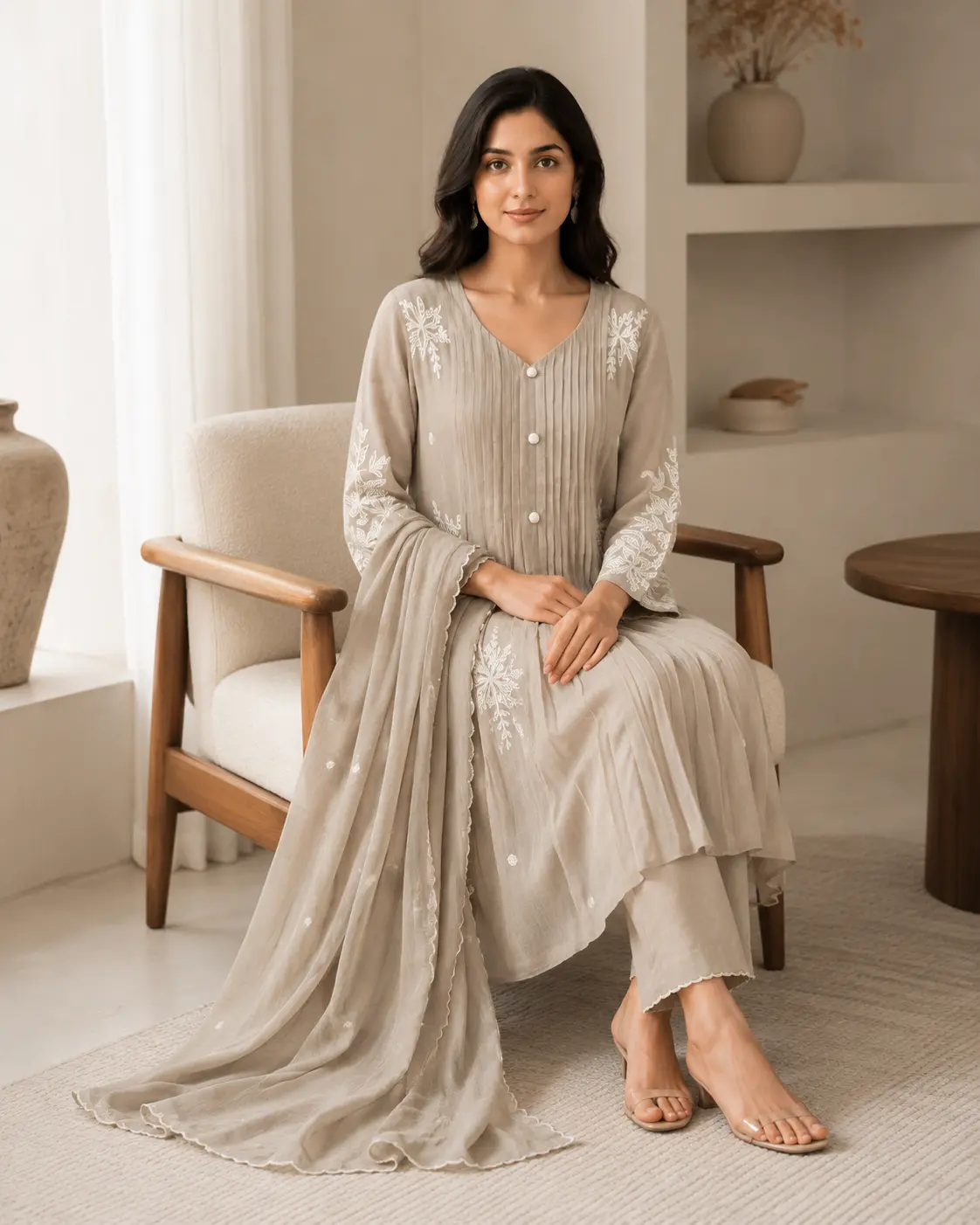
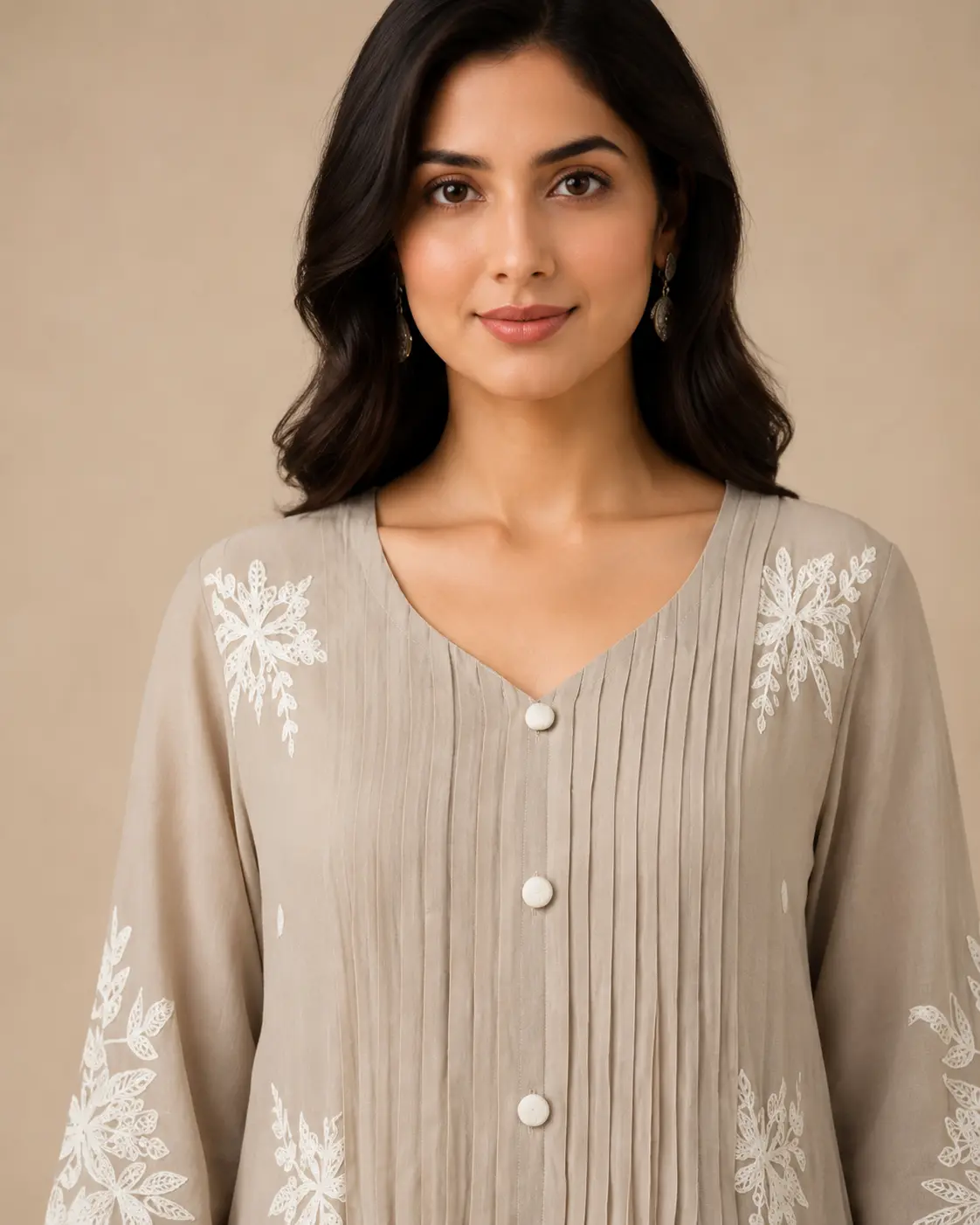
Embroidery can make an Indian workwear outfit feel distinctive without requiring many accessories. Begin by identifying where the main detail sits: neckline, bodice, sleeves, hem or across the fabric. Then decide what should remain quieter. If the neckline already carries decorative work, you may not need a necklace. If the sleeves are the feature, consider whether bracelets add anything useful or simply compete with them.
This is an editing approach, not a ban on expression. Some women feel most like themselves in bright colour and visible jewellery; others prefer very restrained dressing. The useful question is whether the elements work together at normal conversational distance. Stand back from the mirror rather than inspecting only a close-up. If everything asks for equal attention, remove one optional element and compare the effect.
Assess scale, contrast and shine
Small embroidery is not automatically subtle, and large embroidery is not automatically overpowering. A small high-contrast motif can stand out strongly; larger tonal work can read more quietly. Shine also changes the impression. Look at the outfit in ordinary indoor light as well as brighter light so you understand how reflective details appear without relying solely on a carefully lit product photograph.
For a daytime professional event, you might prefer detail that remains visible without dominating the outfit. For an evening reception, you may enjoy a little more contrast or a dressier finish. These are styling options, not rules tied to age, seniority or skin tone. Choose what feels consistent with your role at the event and the way you want to present yourself.
Build colour around pieces you already use
Start with a suit colour you genuinely like and connect it to footwear, a bag or jewellery you own. A coordinated outfit does not require every item to be exactly the same shade. Repeating a similar warmth, depth or level of contrast can make the combination feel intentional. Trying to match several almost-identical colours often creates more work than using a clear supporting neutral.
If you enjoy brighter colour, keep the surrounding pieces simple enough to let it be the focal point. If you prefer neutrals, use texture, embroidery or a thoughtful accessory to add interest. There is no need to claim that a particular shade makes someone authoritative or trustworthy. Colour is a styling choice, not a substitute for what you say. Our Indian workwear colour guide explores practical ways to build combinations.
4. Adapt the outfit to the networking format
A breakfast meeting or small professional roundtable
For a morning event with conversation around a table, begin with a comfortable kurta set and understated accessories. The upper half of the outfit will often be most visible when you are seated, so assess the neckline, shoulder fit and embroidery together. A clean, considered appearance is more useful than extra embellishment added simply because the occasion involves meeting new people.
Choose sleeves that let you handle a cup, take notes or use your phone without fuss. Keep your bag compact enough to place neatly beside or below your chair where permitted. If you will go straight to the office afterwards, do not create a second outfit unnecessarily. A version of your normal polished workwear, carefully prepared, may be the most effective choice.
An industry conference with exhibition stands
At a conference, movement and carrying capacity can become the main considerations. You may stand in queues, walk between halls and keep a badge visible all day. Choose clothing that works with the event lanyard rather than needing to be constantly rearranged around it. If the neckline is a major design feature, check whether the badge will cover it before deciding how much jewellery to add.
Wear shoes you have already used for comparable walking and standing. A bag that fits essentials without being overloaded will make it easier to move between conversations. Think about pockets only if the actual outfit has them and they hold items comfortably; do not assume all suit sets include useful storage. Carry a separate lightweight layer if the venue’s temperature may vary and it fits your plan.
An evening hotel or business-club reception
An evening venue can accommodate a slightly dressier interpretation without requiring a bridal or ceremonial look. You could choose a richer colour, more defined embroidery or one stronger accessory while keeping the rest of the outfit composed. The change should feel like a deliberate step up from your everyday workwear, not an obligation to wear every special item you own.
Standing receptions also involve practical details: balancing a drink, holding a plate and greeting people. Consider a bag you can wear securely or set down appropriately rather than one that demands your hand continuously. Test the dupatta arrangement and sleeve shape with these movements in mind. An elegant outfit loses its ease if you spend the evening guarding fabric from food and shared surfaces.
A creative-industry meetup or informal founder gathering
Informal settings often allow more personal styling, but comfort still matters. You may choose an expressive colour combination, a relaxed silhouette or a distinctive accessory that feels natural to you. Keep the outfit anchored in the actual venue. A café conversation, an outdoor community event and a design-studio evening can each call for different footwear and different levels of layering.
You do not have to dress down beyond your comfort zone to appear approachable. Nor do you need to look corporate simply because the event is professional. A polished Indian outfit can be a consistent part of your personal style across settings. Adjust the finish rather than replacing your identity: quieter jewellery, a practical bag or simpler footwear may be enough.
A panel discussion, speaking engagement or hosted event
If you are speaking, add a technical check to your outfit planning. Ask about the microphone setup if you need to know where equipment will sit. Test the outfit while seated if the panel uses chairs or stools, and consider how the neckline and sleeves behave when you gesture. These checks are about participation and comfort, not about policing how a speaker should look.
When photos or video are expected, view the full outfit on your own phone under similar lighting if possible. Look for distracting bunching, accidental transparency or details that behave differently on camera. Do not assume a colour or fabric will always photograph a certain way. For more preparation ideas, see our guide to Indian outfits for important meetings.
5. Make accessories earn their place
Before adding an accessory, ask what it contributes. It may bring colour, complete a neckline, hold essentials or simply make you feel more like yourself. That is enough. What you want to avoid is adding pieces because an occasion feels important and more seems safer. A single considered pair of earrings can do more for a coherent outfit than several unrelated decorative elements.
Jewellery: consider weight, movement and sound
Choose earrings you are comfortable wearing for the expected duration. If a pair moves a great deal or feels heavy after a short trial, it may not be your best option for an extended event. Necklaces should work with the actual neckline and embroidery rather than crowding them. Bracelets and bangles should allow you to write, use your phone and handle a drink comfortably.
There is no universal requirement to wear small jewellery at a business event. A larger piece may work well as the outfit’s focal point. The test is whether it supports the rest of the styling and lets you participate naturally. If you are recording audio or speaking near a microphone, notice whether jewellery repeatedly touches the equipment or creates noise with movement.
Footwear: test the day, not just the mirror
Choose footwear according to the surface, walking distance and time on your feet. A polished flat, a supportive sandal or a heel you already find comfortable can all be options depending on the dress code and outfit. A heel is not a prerequisite for looking professional. Equally, a flat shoe is not automatically comfortable simply because it has no height.
Try the shoes with the actual bottoms and walk around. Check that the hem clears the ground and does not catch behind the heel. If you will be outdoors, consider uneven paths or grass. Avoid relying on an untested new pair for a long evening. If you need a backup pair, make sure you can carry it conveniently rather than adding a bulky bag you will resent.
Bags: reduce the number of things you hold
Choose a bag around the essentials you need, not the maximum number of things you could take. Your phone, keys, payment method and any event-specific materials should be easy to find. If you need a laptop, use a suitable work bag and accept its practical role rather than trying to squeeze equipment into a decorative bag that cannot carry it safely.
Check how the strap sits with your outfit and whether it repeatedly displaces the dupatta or catches on embroidery. A hands-free style may be useful for some events, while a compact handheld bag may suit a seated dinner. There is no single correct shape. The best choice is the one that works with the event and does not interrupt every introduction.
6. Style for real conversation
Networking involves more than standing still. You may turn between people, lean slightly to hear, reach for a name badge, sit in a low chair or move quickly between sessions. A useful final fitting should imitate those actions. If something shifts each time, solve it before leaving rather than planning to keep adjusting it at the venue.
Give the dupatta a clear role
If your set includes a dupatta and you want to wear it, decide how you will arrange it for the event. A simple drape can provide a finished look, but it should not need constant holding. Test the arrangement while walking and handling your bag. If you choose a pin or another fastening, use it carefully and make sure it does not damage delicate fabric or restrict movement.
Whether you can omit the dupatta depends on the actual outfit, its coverage, the occasion and your preference. Do not assume every three-piece set looks or feels the same without it. Try the complete outfit both ways if you are considering that option. The aim is a considered result in which you feel comfortable, not compliance with a universal styling rule.
Keep your face and name badge easy to engage with
Choose hair and accessories that you can manage comfortably through the event. This does not require a particular hairstyle, makeup routine or beauty standard. It simply means noticing whether you are repeatedly moving hair out of your face or adjusting an accessory that distracts you. Prepare in a way that lets you pay attention to the person in front of you.
If the organiser supplies a badge, wear it as directed and check that your bag strap or dupatta does not cover it constantly. You are there to introduce yourself, and readable practical details can be more useful than another styling addition. Keep any business cards or relevant contact-sharing method accessible so exchanging details does not become a search through the bottom of your bag.
Remember that polished does not mean identical
Professional rooms contain people with different tastes, cultures, bodies and comfort needs. You do not need to look like everyone else to belong there. The more useful standard is whether the outfit fits the event’s expectations, respects any practical requirements and allows you to participate. Indian workwear can be an entirely natural choice rather than something that needs to be justified against Western clothing.
Once the outfit is prepared, turn your attention to the event itself. Decide whom you hope to meet, what you want to learn and how you will introduce your work. Clothing can remove a source of distraction, but it cannot do the conversation for you. A familiar, comfortable outfit often serves that purpose better than a dramatic new look that feels uncertain all evening.
7. Prepare a small, realistic event kit
Pack for plausible needs rather than every possible mishap. Check that your phone has enough charge and that any digital ticket is accessible. Carry the essentials you normally use, plus event-specific items such as identification if the organiser requires it. A small amount of preparation can make arrival calmer without turning your bag into a second suitcase.
For clothing, consider whether you need a compact layer, a safe way to carry a removed accessory or a small pouch for personal essentials. Follow the garment’s own care instructions when preparing it. Do not assume every embroidered piece can be ironed directly, steamed at high heat or treated with the same stain remover. If the care guidance is unclear, ask before experimenting on the day of the event.
The evening-before check
- Read the invitation and confirm the venue, timing and dress code.
- Try the full outfit with the intended footwear, bag and jewellery.
- Sit, walk and reach to check fit and movement.
- Inspect closures, hems and any loose threads without attempting risky last-minute repairs.
- Prepare the garment according to its care label.
- Set aside your essentials and confirm the route.
- Choose a familiar backup outfit if the main option is still uncertain.
Leave enough time for this check that you can make a simple change. The goal is not to discover a new wardrobe problem at midnight. If one item is uncomfortable, replace that item rather than assuming the entire outfit has failed. A different shoe, a quieter accessory or a more secure dupatta arrangement may solve the issue without another purchase.
The five-minute departure check
Look at the outfit once in normal light and check the basics: comfortable fit, clean footwear, working closures and a manageable bag. Confirm that you can find your ticket, phone and keys. Then stop making optional changes. Repeatedly adding and removing accessories just before leaving can create uncertainty without improving the result.
If you are moving directly from work to the event, prepare the transition in advance. One accessory change and a quick refresh may be enough. Keep anything you remove in a pouch rather than loose in your bag. Our office-to-dinner styling guide covers ways to make a coordinated suit set work across the day without changing the whole outfit.
8. Shop with repeat wear in mind
If you decide to buy something for the event, identify the actual gap first. Perhaps you already own suitable clothing but need comfortable footwear. Perhaps the missing piece is a set that works for both meetings and receptions. Buying around that specific need is more useful than searching vaguely for a networking outfit and feeling that everything you own is suddenly inadequate.
Consider at least two other occasions on which you would wear the purchase. Could it work for an ordinary office day with simpler accessories? Could the pieces be worn together in a different setting? Repeat wear does not require a garment to suit every event. It means choosing with your real calendar in mind rather than buying for one imagined perfect photograph.
Check the product description for what is included, the fabric of each piece, measurements and care information. Look carefully at photographs for embroidery placement and garment proportions. Read current delivery and return information on the website before ordering; do not rely on remembered terms or assume an event deadline changes them. Ask for clarification when a detail affects your decision.
You can explore the current Inara Ethnic shop with those criteria in mind. The available assortment may change, so treat this guide as a way to assess the pieces you see rather than a promise that a particular design will remain available. For questions about a specific item’s measurements or construction, use the contact page before deciding.
Frequently asked questions
Can I wear a kurta set to a professional networking event?
Yes, when it fits the event’s dress code and practical requirements. Assess the actual outfit, including fit, detailing, footwear and accessories, rather than assuming Indian clothing is more or less professional by default. A coordinated kurta set can work for many business settings, from daytime discussions to evening receptions, with adjustments appropriate to the occasion.
How do I avoid looking overdressed?
Read the venue and format first, then choose one main source of visual interest. You might keep the embroidery and simplify jewellery, or wear a stronger colour with quieter accessories. Overdressing is not determined by one detail alone. Compare the complete outfit with the event’s expected range of formality and remove additions that do not contribute.
Should I buy a new outfit for every networking event?
No. A familiar outfit that fits well and suits the setting can be a strong choice. You can change the overall impression through footwear, jewellery, a bag or the dupatta arrangement without replacing the clothes. Repeating an outfit is normal. Focus on preparation and participation rather than treating every invitation as a requirement to shop.
What if I will be standing for several hours?
Prioritise tested footwear, a comfortable waistband and a manageable bag. Check the outfit while moving, not only while standing in front of a mirror. Plan for the venue’s surfaces and temperature as far as you can. If the outfit requires repeated adjustment during a short trial at home, choose a simpler arrangement before the event.
Are bright colours unsuitable for networking?
No. Bright colours can work when they suit your preference and the occasion. Think about the total combination, including embroidery, accessories and contrast, rather than banning a colour category. If you want a calmer result, let the colour be the focal point and keep other elements restrained. No shade can guarantee a particular impression or professional outcome.
What is the simplest reliable outfit formula?
Start with a well-fitting suit set appropriate to the venue, add footwear you can comfortably use for the planned duration, choose one considered jewellery element and carry a practical bag. Check the complete outfit in movement. This formula leaves room for personal taste while keeping attention on the essential question: can you spend the event engaging with people rather than managing your clothes?
A final approach: prepared, comfortable and recognisably you
An elegant networking outfit is not a costume for being taken seriously. It is a practical expression of your personal style within a professional setting. Choose clothing that fits your day, balance the details and prepare the small things before you leave. Then let the outfit become the background to what matters: the conversations you have, the ideas you exchange and the connections you decide to continue.
